
Seattle committee hears arts office briefing as funding and space pressures mount
Get AI-powered insights, summaries, and transcripts
Sign Up Free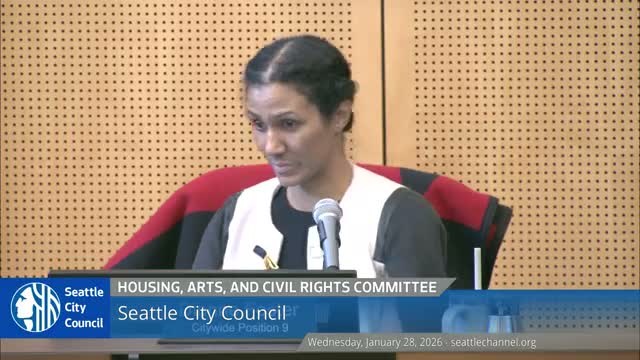
Summary
The Office of Arts and Culture told the City Council Housing, Arts and Civil Rights Committee on Jan. 28 that demand for grants and programs is rising while core revenues fluctuate; members asked for clearer RFP/inventory processes and support for small and immigrant‑serving arts groups.
SEATTLE — The Seattle Office of Arts and Culture briefed the City Council’s Housing, Arts and Civil Rights Committee on Jan. 28 about program priorities, a new strategic plan and growing pressure on grant and operating budgets.
Interim Director Kelly Davidson said the office’s mission is “to activate and sustain Seattle through arts and culture,” and described a multi‑month staff engagement that produced the department’s first five‑year strategic plan. The presentation outlined structural changes in 2025, including a new Creative Placemaking division and an added policy and racial equity staff position to support long‑term planning and program development.
Why it matters: Davidson and finance staff told council members that applications and demand for grants have jumped while main revenue streams are unstable. The office relies heavily on two sources: the 1% for Art ordinance (a capital set‑aside) and an admissions tax on tickets, which staff said is a 5% ticket tax that fluctuates with tourism and event activity. In 2026 the office also received nearly $1.5 million in one‑time council allocations for specific projects, staff said.
Key details: Davidson said the Centering Art and Racial Equity program recently awarded funds to nearly 250 organizations and that the current applicant pool tops 300 organizations. Staff clarified that awardees break down by organizational budget as follows: 32% under $50,000; 36% between $50,000 and $500,000; 18% between $500,000 and $2,000,000; and 14% above $2,000,000. The office plans to present evaluation findings from its recent survey of grant recipients.
Programs and partnerships: The office highlighted longstanding public art programs (in place since 1973), the Creative Advantage school partnership (now operating in all 106 Seattle Public Schools), the Pivot pilot (a two‑year cohort program to help arts organizations restructure operations), and World Cup‑related activations designed to drive visitors to neighborhood commercial corridors. Staff said they are exploring both short‑term activations and longer‑term partnerships for sites such as the Denny Substation with Seattle City Light, and continue work with Langston Hughes Performing Arts Institute and King Street Station gallery.
Council response and requests: Committee members pressed staff on how programming will serve immigrant communities, capital versus operating needs for cultural spaces, and interdepartmental partnerships. Council Member Lynn asked about using arts as a health intervention; Davidson noted growing interest in 'arts prescribing' and cited Path With Art as a local partner. Council Member Juarez requested a central inventory or public list showing arts RFPs, who applied, and who was awarded work (including projects involving indigenous communities and waterfront commissions) to improve transparency and outreach; Davidson agreed to produce an overview clarifying jurisdiction and contacts.
Claims and follow‑up: Kenneth Randolph, a public commenter who identified himself as an immigrant and refugee, said all 15 positions on the city’s immigrant and refugee advisory commission were vacant and asked the committee to help restart appointments; Chair Dion Foster said staff would follow up and collect contact information. Manny Kuali, executive director of Inspire Washington, urged continued civic investment in the creative economy and cited a cultural access package he said has generated $117,000,000 across five jurisdictions.
Budget constraints and planning risk: Finance staff described a post‑pandemic shift to same‑year forecasting for admissions tax revenue, with thrice‑annual revenue forecasts that make multi‑year planning difficult. The Municipal Art Fund is highly restricted and cannot be used to offset shortfalls in admissions tax revenue, staff said; the guiding legislation also requires a 20% rainy‑day reserve for some funds.
What’s next: The committee asked the office to return with evaluation findings, a clearer contact and jurisdictional inventory for arts procurement and partnerships, and additional detail on how new programs like Pivot will target small and immigrant‑serving organizations. The committee’s next meeting is scheduled for Feb. 11 and will focus on housing.
Ending: The committee adjourned at 2:57 p.m.