Get Full Government Meeting Transcripts, Videos, & Alerts Forever!
Get email alerts on the Energy Waste Reduction topic
No spam. Unsubscribe anytime.
Coldwater utility approves revisions to local Energy Waste Reduction plan, including electrification rebates
Summary
The Coldwater Board of Public Utilities approved revisions to its Energy Waste Reduction plan for 2026–2027, keeping a local (opt-out) program and adding rebates for electrification measures, a low-income assistance program and EV charger incentives before submitting the plan to the Michigan Public Service Commission.
The Coldwater Board of Public Utilities voted Oct. 1 to approve revisions to the utility’s Energy Waste Reduction (EWR) plan for 2026–2027 and authorized staff to submit the updated program to the Michigan Public Service Commission.
Monica McKown, who identified herself as working with CBPU key accounts and energy waste reduction, told the board the program is grounded in Public Act 295 of 2008 as amended by Public Act 342 of 2016 and described two compliance paths: opt in to the state-run plan or opt out and run a local program. "In doing so with the state plan… the estimated cost to participate in this plan is between 3 and 3.5% of the previous retail sales," McKown said, adding that the local estimate for CBPU participation would be "approximately $1,500,000." She said staff recommend continuing a local opt-out program because state participation would carry higher direct costs and limit local flexibility.
The board-approved revisions add new allowable measures and customer-facing incentives. McKown outlined proposed rebates including electric lawn tools (with a $25 rebate for a new electric string trimmer and up to $50 when customers recycle a gas trimmer through BizAid), induction cooktop rebates for residential units with a minimum of three elements, and commercial rebates such as electric forklifts. She also proposed residential EV charger installation rebates capped at $500 for level-2 chargers, $2,000 per level-2 commercial charger, and $5,000 per level-3 fast charger.
McKown flagged a new low-income spending requirement in state rules that requires at least 25% of program spending be targeted to low-income customers. To meet that requirement, staff proposed a CBPU Low Income Energy Efficiency Assistance program that would provide up to $5,000 per eligible household for energy-efficiency upgrades, subject to income and residency requirements.
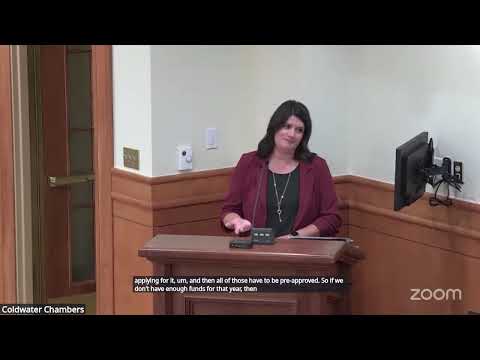
Board members asked how CBPU will reach the 25% low-income threshold. McKown said the utility will preapprove applicants, set funds aside based on prior-year sales and rely on targeted education and marketing to drive enrollment. "We have to set enough aside of what our previous year was for that program," McKown said, adding that some utilities statewide are wrestling with the same requirement and that offering the program locally is the most practical option for Coldwater.
The board made and carried a motion to approve the EWR program revisions and authorize staff to submit them to the Michigan Public Service Commission. If the MPSC review proceeds as expected, staff said they will continue local implementation and update the board on enrollment and budget impacts.
The revisions the board approved will now be forwarded to the Michigan Public Service Commission for review before local implementation begins in 2026.