Get Full Government Meeting Transcripts, Videos, & Alerts Forever!
Get email alerts on the Transportation Roundabouts topic
No spam. Unsubscribe anytime.
Wenatchee staff and consultant recommend mini roundabout for Crawford and Okanagan, highlight pedestrian treatments
Summary
City staff and a traffic consultant briefed council on roundabout safety and preliminary findings for a proposed mini roundabout at Crawford and Okanagan, citing crash-reduction evidence and local case studies while council and residents pressed for pedestrian beacons, sight-line fixes and budgeted retrofits.
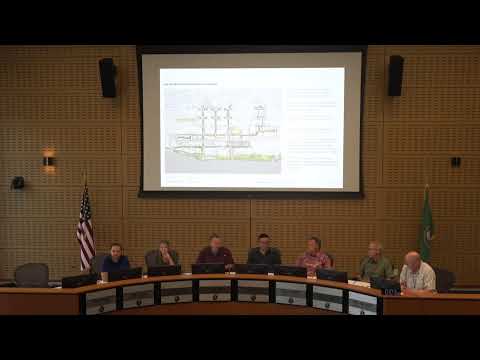
City of Wenatchee staff and an outside traffic consultant presented an educational briefing on roundabouts and said a mini roundabout at Crawford and Okanagan appears context-appropriate, while council members and residents raised pedestrian-safety concerns and asked staff to pursue targeted safety treatments.
Sean Samsel, the consultant leading the presentation, summarized decades of research and local experience showing that roundabouts can reduce severe crashes and lower overall collision severity. "You can see, as much as 82% reduction in severe crashes," Samsel said, citing synthesis findings from crash-modification databases and national studies. He added that overall crash counts across treated intersections typically fall substantially and that roundabouts tend to convert higher-severity crossing crashes into lower-speed merging or sideswipe conflicts.
Samsel reviewed two local case studies. At the Western and Springwater mini roundabout, he said police reports showed an average of about 1.4 crashes per year in the six years before the mini roundabout and roughly 1.1 crashes per year in the 5½ years after installation; importantly, he reported "no injury crashes" involving pedestrians or bicyclists in the post-installation period. In a second suburban example he presented, a location with four injury crashes in two years saw only one low-severity injury crash in four years after a roundabout, which Samsel described as a roughly 90% reduction in injury-rate.
The consultant explained key design features and trade-offs for mini and single-lane roundabouts—inscribed diameter, splitter islands, truck aprons, crosswalk setbacks, and treatments for visually impaired users—and recommended a data-driven screening (the Intersection Control Evaluation, or ICE) to compare roundabout options with alternatives based on safety, operations and cost.
For the Crawford and Okanagan intersection specifically, Samsel said traffic counts place the location in a likely acceptability band for a single-lane or mini roundabout. "This intersection has just about 13,000 [ADT]," he said; he noted Crawford is about 11,000 ADT and Okanagan about 2,000 ADT, with the minor-street share near 16 percent, which typically allows a single-lane solution to function acceptably in many contexts.
Council members and residents focused questions on pedestrian visibility and driver behavior at local roundabouts. One council member and several residents pointed to a large shrub at the Springwater/Western intersection that blocks sight lines; Samsel confirmed he had observed the same obstruction during a field review and recommended checking sight-distance limits and clearing or trimming plantings where they reduce visibility. Staff noted the city’s local code for sight-line clearance (setback at roughly 25 feet) and said they would review the site.
On pedestrian aids, Samsel and staff recommended including actuated rectangular rapid flashing beacons (RFFBs) in projects when feasible. "I’m a big advocate for that treatment in terms of the visual differentiation and alertness that it gives drivers," Samsel said. He also discussed speed-feedback signs, raised crosswalks or speed tables and low-profile rumble strips as engineering options to slow drivers approaching roundabouts; he noted budget limits influence whether retrofits are possible and that some features (like RFFBs) have become easier to deploy as off-the-shelf, solar-powered packages.
Staff and council emphasized education and outreach—posting short instructional videos and project renderings online and conducting before-and-after surveys—as critical to shifting public perception. Samsel said his case studies generally showed mixed public opinion before construction but high (often >90%) satisfaction after construction and outreach.
No formal motion or vote on the Crawford and Okanagan design was recorded in the transcript; staff described the presentation as an early-stage concept briefing. Council directed staff to continue outreach, to consider pedestrian-beacon funding where possible, and to meet with nearby stakeholders after the session to gather further input.
What’s next: staff will follow up with more detailed design and public outreach tied to the Crawford–Okanagan mini roundabout project; any formal adoption or funding decision would return to council as a distinct agenda item.