Get Full Government Meeting Transcripts, Videos, & Alerts Forever!
Get email alerts on the Parklands Ordinance topic
No spam. Unsubscribe anytime.
Coldwater council adopts update to parklands ordinance after public concerns about permits and prohibitions
Summary
The council approved amendments to Chapter 10.64 (Parklands) intended to modernize 1998 language and clarify enforcement; speakers raised concerns that provisions could require permits for auctions, banners, chalk drawings and picking flowers, and staff said officers retain discretion and the permitting route aligns with existing reservation processes.
Coldwater’s City Council on Jan. 26 adopted revisions to Chapter 10.64 of the municipal code governing conduct in city parks, a measure city attorneys said updates language from 1998 and clarifies which violations may be enforced criminally.
City Attorney Amanda O'Boyle told the council the changes are largely a cleanup of outdated text and add clarity about certain prohibited acts and the potential for some violations to be designated as misdemeanors so police can investigate alleged crimes. O'Boyle said the ordinance does not introduce many of the items that drew public comment; rather, “these were in existence” and the update provides clearer language and enforcement options while allowing officer discretion when encounters arise.
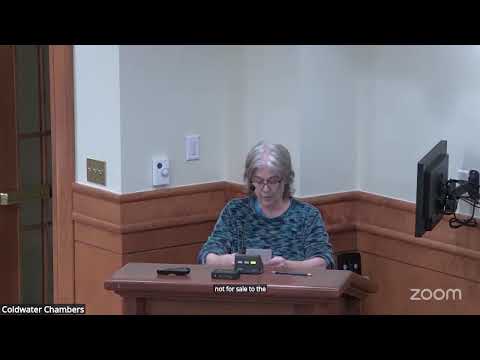
Public speakers raised specific worries about how the rules would be applied. Louise Collins, who said she lives at 27 Michael Drive, asked whether the ordinance would require permits to "sell, offer or solicit for sale any goods or merchandise" and whether temporary signs, banners, chalk drawings or even a child picking a dandelion could be treated as violations. O'Boyle said private gatherings at a reserved pavilion generally would be permitted and that permit processes for reserved spaces are handled through the recreation department; she also said the law gives officers discretion to decide whether an act rises to criminal conduct.
Council members and staff described the permitting approach as consistent with existing reservation policies for pavilions and with other city permitting (staff compared it to a door-to-door registration in form). The council moved the ordinance on for final passage and, after discussion and confirmation from staff that pavilions and some park uses remain available to the public, adopted the amendment by motion with no roll-call objections.
Beyond the ordinance text, several speakers urged the city to consider how rules would affect typical community uses—family reunions, graduation banners, children's chalk games—and asked for clarity on how permits are issued and which park properties fall under the municipal master plan. Council members directed staff to rely on the recreation department for pavilion reservations and neighborhood services for enforcement follow-up.
The council adopted the amendment to Chapter 10.64 at the Jan. 26 meeting; O'Boyle said officers retain discretion in enforcement and the city will rely on permit channels already used for reservable park facilities.