Get Full Government Meeting Transcripts, Videos, & Alerts Forever!
Get email alerts on the Stormwater Infrastructure topic
No spam. Unsubscribe anytime.
Winnetka outlines Pershing Street stormwater design; residents press for pipe coordination and traffic calming
Summary
City of Winnetka staff presented final-design elements for stormwater improvements on Pershing Street, including infiltration trenches and a slight 1% road-grade change; residents asked the city to coordinate with a reclamation-district pipe, provide irrigation records, and consider traffic-calming after construction.
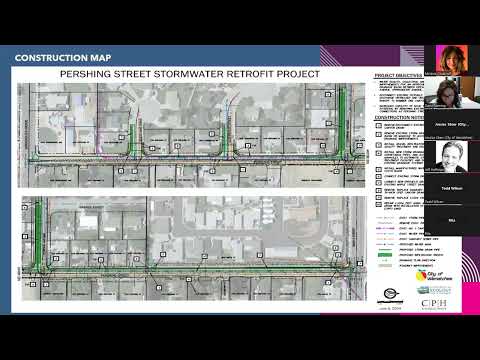
Winnetka — City project manager Darcy Ronning presented a near-final design for stormwater improvements on Pershing Street and adjoining blocks on Thursday, saying the work aims to capture runoff with infiltration trenches and use existing curb lines to direct water into new storm infrastructure.
“This is Darcy Ronning, project manager with the City of Winnetka,” Ronning told attendees as she opened the meeting and shared design graphics. She said the presentation covers the final roughly 10% of design work and that the project area shown on maps runs from Springwater to Central and from Central to Neil.
Ronning described the area as served by a natural drainage that has been piped beneath streets and backyards, which can overflow during large rain events. To address that flooding, the city is proposing green infrastructure placed along the street and within the public right-of-way. “We’re gonna change the road grade slightly, but literally just 1%,” Ronning said, describing a small tilt to streets to route more runoff into infiltration galleries without materially affecting driveways.
Residents raised several specific concerns during a public-comment period. A resident who identified their home as 1217 Pershing Street recounted being “a victim to the Springwater Creek flooding in 2016” and welcomed the proposed improvements. Multiple residents asked the city to coordinate with a reclamation district whose older pipe runs through the canal in the project area; one resident said the district has historically repaired that pipe and asked staff to inspect exposed utilities while trenching occurs.
Ronning acknowledged irrigation connections are a challenge for the design team, saying private irrigation maps are often out of date and inviting residents to send maps and photos to help staff avoid damaging private services. She also reported the project held a public meeting the previous night with eight attendees and encouraged further neighborhood engagement.
On traffic issues, residents said speeding and truck parking are recurrent problems on the street and suggested traffic-calming measures such as roundabouts. Ronning said transportation engineers will evaluate traffic-calming as a separate, follow-on study after the stormwater construction and that some measures could require additional right-of-way work or engineering beyond the current project’s scope.
The city did not take formal action or vote at the meeting. Staff said they will continue outreach, accept resident-submitted maps and photos, and coordinate inspection of exposed utilities during construction. Additional neighborhood conversations and technical reviews with transportation staff were described as next steps.