Get Full Government Meeting Transcripts, Videos, & Alerts Forever!
Get email alerts on the Land Use topic
No spam. Unsubscribe anytime.
Planning commission postpones decision on proposed tire shop at 36 East Chicago Street over parking and safety questions
Summary
Coldwater planning staff recommended against approval of a special land use for a small tire shop at 36 East Chicago Street, citing insufficient parking plans, pedestrian-circulation and intersection-safety concerns; the commission postponed a decision and directed the applicant to submit a revised site plan addressing those items.
The Coldwater Planning Commission on Monday postponed consideration of a special land use request to open a small tire repair shop at 36 East Chicago Street after staff and several commissioners said the application lacked necessary details about parking, pedestrian circulation and traffic safety near the intersection of US 12 and South Hudson Street.
Robert, the city planner who presented the item, told the commission that while several non-discretionary site-review standards had been met, the application did not sufficiently demonstrate compliance with key standards related to “adequacy of information, pedestrian safety, vehicle circulation and parking.” He highlighted a recorded 10-foot easement along the southern portion of the property that makes some proposed spaces unusable and said his calculations found only four usable on-site spaces compared with seven shown on the plan. “Until these issues are adequately addressed…staff cannot support the special land use request,” he said.
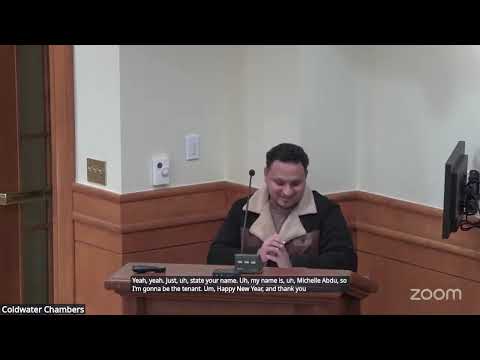
Applicant Michelle Abdul, who said she would be the tenant, described the proposed business as a small, in-and-out tire operation with a maximum of two employees and no planned overnight storage of customer vehicles. “It doesn’t require a lot of parking because it’s in and out, same service,” Abdul said, adding that removed tires would be stored inside and collected by a supplier once or twice a week.
Nathan Wilburn, owner of the adjacent auto parts store, told the commission his chief concern was parking and the potential for overflow into shared lot spaces. “There’s a parking issue. We all know it,” Wilburn said, noting the tight configuration of shared parking in the block and urging a practical solution. He said many of the matters raised by the applicant sounded “like they’re already handled, but…there are only so many spots.”
Commissioners pressed for firm documentation rather than verbal assurances. They noted missing items enumerated in staff comments — traffic patterns, parking layout and dimensions, refuse storage and vehicle maneuvering radii — and expressed reluctance to approve based on conditions alone. A motion to deny the application produced a 3–3 tie and failed. The commission then voted to postpone the item and directed staff to work with the applicant to provide a revised site plan showing parking counts that account for the recorded easement, pedestrian-circulation measures to avoid blocking the public right of way, refuse-storage details and any required maneuvering and turn-radius dimensions.
The chair said staff would meet with the applicant to “figure out what the maximum amount of parking could be provided on the property without impeding the known easement,” and return to the commission with a revised filing.
Next steps: the applicant must submit a revised site plan and supporting details that address the staff’s concerns; the commission will hear the application again at a future meeting.