San Mateo council hears $267 million storm drain master plan update; Marine Lagoon is largest project
Loading...
Summary
City staff and consultant presented a storm drain master plan update that identifies $267 million in CIP needs, including a roughly $121 million Marine Lagoon pump station project; council directed staff to keep a $250,000 annual allocation for localized ponding projects, explore bonding for a $39.1 million tranche, and advance public outreach and mapping tools.
San Mateo — City staff and the consultant Schauff and Wheeler on Monday presented an informational update to the council on the city’s storm drain master plan, outlining a $267 million capital program and seeking direction on prioritization, bonding and public outreach.
Jimmy Bowe, senior engineer with San Mateo Public Works, said the plan’s technical analysis and modeling — validated with neighborhood flooding photos — show most pipe infrastructure is in generally good structural condition but that several pump stations and localized areas need investment. "The projects without climate change for the stormwater program for the city of San Mateo is $233,000,000. If we include climate change for $34,000,000 the grand total becomes $267,000,000," Bowe said, adding that the Marine Lagoon pump station represents about $121,000,000, roughly 44–45% of the total program cost.
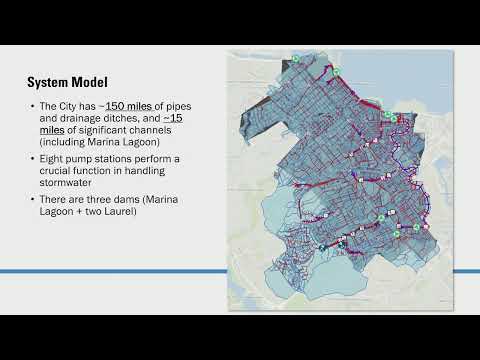
The consultant, Dan Schauff of Schauff and Wheeler, said the analysis covered about 150 miles of storm pipe and used CCTV inspections and hydraulic modeling — including a neighborhood calibration in Sunnybrae — to prioritize work by flood depth, duration, properties affected, cost and equity. "We looked at the condition... some maintenance issues, but overall most of the pipe in the city is in good condition," Schauff said, noting the modeling uses a 10-year design standard for pipes and a 100-year standard for creeks and larger pumping facilities.
Council members broadly endorsed the prioritization framework and emphasized balancing large, system-wide projects against visible neighborhood improvements. Council member Svirko Gaditsky asked about aging pump stations flagged as high risk at 42nd Avenue and Detroit; staff replied those stations are older and likely need pump and system replacements. Several members expressed conditional support for using stormwater revenues to bond for a targeted tranche of very-high projects — roughly $39.1 million — provided clear debt limits and reporting are established.
On localized "ponding" problems, staff described typical fixes ranging from about $50,000 to $100,000 per site though costs vary by solution and site conditions. Bowe said the city has completed multiple smaller-scale projects since the stormwater fee passed in 2024 and recommended an initial annual allocation of $250,000 to aggregate and deliver these localized projects effectively.
Public outreach is planned around a bilingual stormwater mapping tool that will let residents pin flooding locations and submit photos and videos; staff said the draft master plan will be released for public review in late February or early March, with additional community meetings planned in the spring.
Staff noted revenue constraints that limit the city’s immediate bonding capacity: annual stormwater revenue is about $4 million with roughly $600,000 paying ongoing operations and maintenance, leaving an estimated $2 million potentially available for debt service. Because the Marine Lagoon project significantly exceeds what staff expect the city can bond against current revenues, they recommended pursuing state and federal grants for that larger project while using bonding and other financing strategies for smaller very-high projects.
Next steps: staff will release the draft master plan for public comment, retain the mapping tool long term, pursue grant opportunities for the Marine Lagoon work and return later in the year with options for bonding and more detailed funding strategies. The council indicated consensus on the priority list, directed staff to explore bonding and to keep the $250,000 allocation for localized projects as a starting point. The special meeting was adjourned; the council will reconvene for its regular meeting at 7:00 p.m.