Get Full Government Meeting Transcripts, Videos, & Alerts Forever!
Get email alerts on the Stormwater Maintenance topic
No spam. Unsubscribe anytime.
Sarasota commissioners approve expanded stormwater maintenance plan, pause regulatory changes pending state action
Summary
After public pleas to dredge Phillippi Creek and other waterways, the Sarasota County Commission voted to adopt a new maintenance-level direction and unanimously paused regulatory changes until Tallahassee completes action on Senate Bill 180. Staff outlined funding options and a planning-level $10M/year waterways estimate.
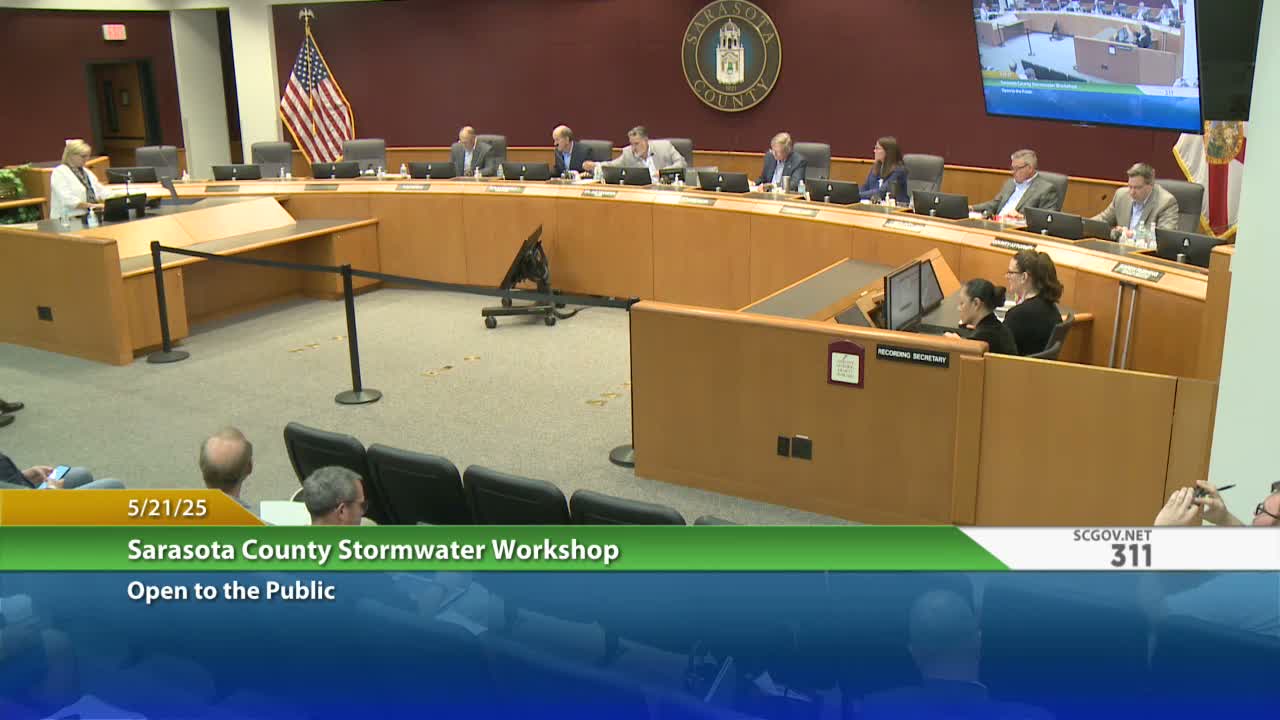
Sarasota County commissioners on May 21 approved a new direction for stormwater maintenance that would expand routine dredging and creek maintenance and asked staff to return with detailed budget impacts, while also pausing proposed regulatory changes until a pending state bill is resolved.
The board voted unanimously to adopt the presentation’s proposed level of service after a multihour stormwater workshop that featured an hour of public testimony urging county action on Phillippi Creek and other local waterways. "We respectfully request that the commission also direct county staff to commit funds from the regular maintenance budget to clear Hog Creek, the 47th Street and 10th Street canals," Kelly Brown, representing the Coalition of City Neighborhood Associations, told commissioners during public comment.
Why it matters: Residents described repeated flooding tied to silted creeks and urged the county to take long-term responsibility rather than rely on homeowners or narrow navigable-channel projects. Staff said the county’s current stormwater program and a separate Navigable Waterways program have been insufficient to address widespread sedimentation and growth-driven runoff, and outlined how a new maintenance schedule and added responsibilities could work.
What staff proposed: Spencer Anderson, Sarasota County Public Works Director, presented a package of operational and capital recommendations including an integrated asset-management interface, more frequent inspections, prioritized (tiered) maintenance of inlets and canals, and an option to add creeks and streams into the stormwater utility’s scope of work. Anderson described a planning-level estimate of roughly $10 million per year to fund routine waterways (creeks/oxbows) maintenance plus other enhancements—a figure he repeatedly characterized as preliminary and subject to refinement as permits and detailed designs are completed. "We are currently working on integrating those two systems," Anderson said of the GIS and maintenance history databases that will let the public and staff see asset histories and better target work.
Public pressure and dredging timeline: Multiple residents urged immediate dredging of Phillippi Creek and nearby bayous. "The idea that residents should bear the cost of dredging Phillippi Creek in perpetuity is unacceptable," said Nadia Bowen of the Southgate Community Association. Staff explained a two-phase approach: Phase 1 targets storm-related "high spots" in the main channel and was submitted to the U.S. Army Corps of Engineers under an expedited review on April 13; Phase 2 would pursue a full permit to address oxbows and broader bank-to-bank maintenance where feasible. Anderson warned that full bank-to-bank dredging near private seawalls could risk destabilizing aging structures and that design must avoid harming adjacent private infrastructure.
Regulatory pause: Commissioners also moved to pause proposed regulatory changes discussed at an earlier workshop until the state’s pending Senate Bill 180 is finalized. Commissioner Knight moved the pause "until such time as either the governor signs it or he doesn't," citing the bill’s potential to preempt more restrictive local rules; the board approved the motion unanimously.
Funding options and next steps: Anderson outlined three broad funding approaches for expanded waterways work: (1) increase stormwater utility fees (equivalent billing unit increase), (2) a countywide ad valorem millage, or (3) project-by-project assessments (MSBU-style). He showed a sample scenario in which first-year costs that include one-time equipment purchases could raise the per-billing-unit fee more substantially in year one before settling to a smaller monthly increase in subsequent years. Anderson and commissioners repeatedly emphasized the $10M figure is a planning-level estimate that will be refined. Staff said they expect to leverage the county’s SRQ resiliency funds and other federal/state grants where possible to reduce rate impacts.
What the board directed: Commissioners asked staff for a series of follow-ups: (1) a clear breakdown of current stormwater fund expenditures (roughly $27M collected in the most recent year), (2) comparative data on stormwater fees and services in similar counties, (3) the permit status and timeline for Phillippi Creek segments submitted to state and federal agencies, (4) public tutorials on the asset/GIS map, and (5) a detailed budget impact analysis on any proposed fee or ad valorem changes. Chair closed the meeting saying staff will return with those details.
Votes at a glance: The board recorded two formal motions during the workshop. The board unanimously voted (5-0) to pause proposed regulatory recommendations pending action on Senate Bill 180; the motion was made by Commissioner Knight and seconded by Commissioner Mast. Later the board unanimously approved (5-0) the presentation’s proposed level-of-service direction to expand maintenance scope; the motion was made by Commissioner Mast and seconded by Commissioner Smith.
What to watch: Staff’s permit response from the Army Corps for the Phase 1 Phillippi Creek work, the detailed cost model showing how any new maintenance program would be funded and apportioned among ratepayers, and the county attorney’s review of ordinance language tied to the stormwater utility’s permissible scope of work. The county will return with those items for further board consideration.
Ending note: Commissioners emphasized urgency for maintenance actions ahead of hurricane season, but also cautioned that dredging and bank work requires careful permitting and engineering to avoid unintended consequences for private seawalls and downstream properties.