Get Full Government Meeting Transcripts, Videos, & Alerts Forever!
Get email alerts on the CDBG Water Project topic
No spam. Unsubscribe anytime.
Public raises groundwater and state‑preemption concerns at CDBG well hearing; commissioners ask FAC to evaluate House Bill 479
Summary
During a CDBG public hearing on a proposed water well and elevated storage tank, an online resident asked whether hydrologists would study Mill Pond impacts; another commenter urged the commission to examine House Bill 479’s potential limits on local authority. The board authorized staff to seek input from the Florida Association of Counties.
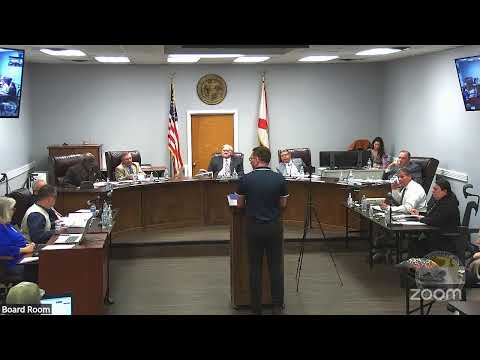
Jackson County opened a public hearing on a Community Development Block Grant (CDBG) small‑cities application proposing a new water well and elevated storage tank.
Tanya Lindback, participating online, asked whether the well site selection process would include hydrologists to ensure pumping would not lower the Mill Pond. County staff and commissioners said the well site has not yet been determined and that the county would engage a professional engineer to select the well location and protect groundwater resources.
Sally Baptist, a public commenter, raised concerns about Florida House Bill 479, which she said would restrict local governments’ ability to regulate activities near wetlands and could limit municipalities’ options. Commissioners discussed contacting the Florida Association of Counties (FAC) for a briefing on the bill and its potential effects on the county’s planned well project.
Commissioner (Speaker 3) moved to direct staff to investigate House Bill 479 and to ask FAC to advise whether the bill could adversely affect the county’s well project; the motion was seconded and passed by hand vote.
What happens next: staff said the county will retain engineering expertise for site selection and will contact FAC for an assessment of House Bill 479; the commission requested a report back to inform whether the county’s planned project remains feasible under any changes to state law.