Get Full Government Meeting Transcripts, Videos, & Alerts Forever!
Get email alerts on the Education Funding Mssm topic
No spam. Unsubscribe anytime.
Committee hears extensive support for LD 2008 to boost funding, clarify tuition rules for Maine School of Science and Mathematics
Summary
Sponsors and MSSM leaders told the Legislature’s education committee LD 2,008 would add $650,000 annually and a one‑time $405,000 dorm repair appropriation to stem staffing losses, reduce room‑and‑board barriers and clarify what sending districts must pay; the committee took testimony and deferred action to work session.
Senator Nicole Grochowski introduced LD 2,008 on behalf of the Maine School of Science and Mathematics (MSSM), asking the Joint Standing Committee on Education and Cultural Affairs to appropriate $400,000 per year in ongoing operational funds, $250,000 per year for in‑state financial aid and $405,000 in one‑time funding to address deferred dormitory repairs.
"MSSM is an outlier when it comes to its school funding model," Grochowski told the committee. She said the bill would also amend statute so that sending school administrative units (SAUs) that do not operate a secondary school would reimburse MSSM via the tuition mechanism rather than by paying room and board directly, a language change recommended by the Attorney General’s office to address unequal treatment across students' home districts.
Rob Constantine, MSSM’s executive director, described three ongoing challenges: statutory ambiguity about what sending districts must pay, a state operating appropriation that has been essentially flat since 2017, and deferred maintenance on state‑owned facilities. Constantine told the committee the school's current baseline appropriation is $3,615,437 and said flat funding has forced cuts in staff (from roughly 45 FTEs to about 36), limited discretionary spending and pushed room‑and‑board charges to about $10,850.
Committee members pressed for operational details. Representative Sheila Lyman and others asked about enrollment and student residency; Constantine said MSSM currently enrolls about 113 students and has a practical capacity of roughly 130–135. He said about 35% of students receive financial aid and the school uses roughly 10% of its appropriation for aid; a larger ongoing appropriation, he said, would let the school reduce the burden on families and avoid deferring maintenance.
Supporters at the hearing — including Senator Sue Bernard, board and foundation members, alumni and parents — stressed MSSM's statewide value. Senator Bernard noted MSSM’s statewide recruitment, its contributions to Limestone’s economy and the role of residential life in the curriculum. Foundation and alumni representatives described recent growth in philanthropic giving but acknowledged private giving cannot substitute for stable state funding.
Several parents and town officials urged the committee to clarify sending‑district obligations so rural families are not priced out of admission. Rob Constantine and others said shifting the statutory obligation to a tuition mechanism (rather than explicitly room and board) would allow sending districts that already contribute tuition for students sent to out‑of‑district schools to provide similar support for MSSM students without imposing new and unequal burdens.
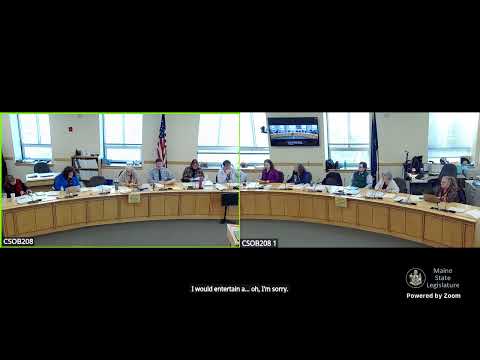
The committee took extensive testimony and questions; the hearing closed with the matter moved to a later work session and further consideration by the committee.
Next steps: the committee will review the bill, agency reports and the Department of Education material at work session before any committee recommendation or recorded vote.