
Clay County planning panel approves two community solar projects and a 1-MW CUP amendment
Get AI-powered insights, summaries, and transcripts
Subscribe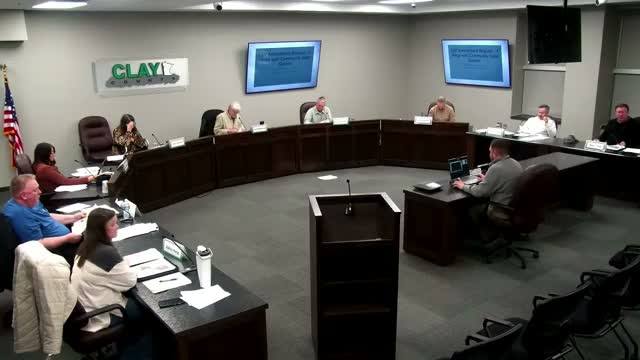
Summary
The planning commission approved a 1-megawatt community-solar amendment near Felton and a 4.75-megawatt community solar garden north of Sabin, subject to standard conditions, screening and access permits; commissioners discussed prime farmland loss and pollinator habitat.
The Clay County Planning Commission on Jan. 20 approved multiple community solar projects and a conditional-use amendment, finding the proposals conform with county requirements for community solar gardens and include measures for screening, decommissioning and pollinator habitat.
Staff presented an amendment for a previously permitted 1-megawatt community solar garden near Felton, noting a required MnDOT access permit for a revised driveway alignment and an estimated decommissioning cost in the tens of thousands of dollars. Norman Ochman of Novel Energy Solutions (online) and company colleagues said the site selection was driven by terrain, existing electrical infrastructure and landowner participation; the project will interconnect to Xcel Energy and provide on-site pollinator habitat. The planning commission approved the CUP amendment with the county’s standard conditions.
The commission then considered a larger proposal from Buffalo River Garden LLC for a 4.75-megawatt community solar garden on roughly 28.8 acres of farmland north of Sabin. Developer Fritz Ebinger (Nokomis Energy) described the project’s role in the Xcel Energy community-solar program for low- and moderate-income subscribers, expected annual generation and the requirement to establish approximately 28 acres of native pollinator habitat during operation. Staff reported estimated revenue from the solar production tax would be distributed to Clay County (80%) and the township (20%) and that the applicant provided a financial guarantee for decommissioning.
Commissioners raised concerns about taking prime farmland out of production, visual impacts and whether additional screening should wrap around nearby residences. Some commissioners noted the projects are relatively small in the countywide context and that native vegetation under the arrays can improve soil health and water infiltration compared with some other land uses. On a motion and second, the commission approved the 4.75-megawatt conditional-use permit with five standard conditions; one commissioner voted in opposition and the rest voted for approval.
What’s next: Applicants must secure required permits (for example, MnDOT access and any utility permits) before construction; the projects anticipate staged construction in 2026–2027 depending on equipment supply and interconnection timing.