
Rep. Heather Keeler briefs Clay County on PRTF funding, bonding push and next phase for juvenile services
Get AI-powered insights, summaries, and transcripts
Subscribe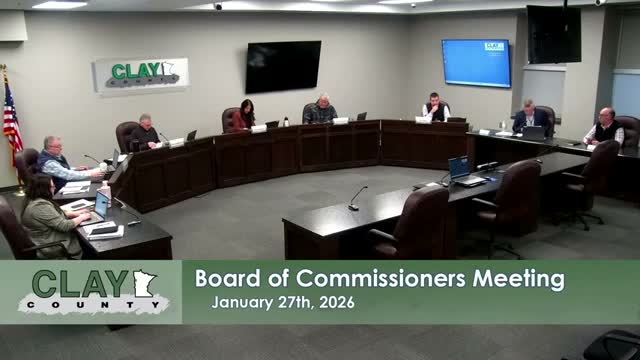
Summary
State Rep. Heather Keeler told the Clay County Board that $1 million was secured for a psychiatric residential treatment facility (PRTF) and that legislators are shifting focus to funding a non‑secure juvenile detention center; she urged county officials to help build bipartisan support during the upcoming bonding session beginning Feb. 18.
Representative Heather Keeler gave a legislative briefing to the Clay County Board of Commissioners on the status of regional juvenile services and the county’s bonding request.
Keeler said the 2025 session produced a $1,000,000 allocation dedicated to the PRTF (psychiatric residential treatment facility) and described that as a legislative success born of sustained local advocacy. "We had a large deficit in the budget and we were still able to get the $1,000,000 dedicated to the PRTF," she said.
Keeler said the legislative effort is moving into a new phase: lawmakers are now focused on funding and policy work for a non‑secure juvenile detention center and on securing bonding to cover the project’s brick‑and‑mortar costs. She told the board the 2026 session opens Feb. 18 and noted it is a shorter session focused on policy and bonding. "Now we're on to the next phase, which it feels like... the non secure juvenile detention centers," she said, urging county leaders to help build support among legislators and partner counties.
On local match rules, Keeler said the bonding process allows some flexibility: services can be counted toward the local match rather than requiring a strictly brick‑and‑mortar match. "When they were saying we needed a match, it had to be brick and mortar match... That's actually not the case," she said, adding the committee has framed staffing as part of the match in recent presentations.
County commissioners asked whether neighboring North Dakota counties could participate or help finance use of facilities. Keeler said there had been no formal discussions on North Dakota participation for the non‑secure facility and that Minnesota demand remains the primary driver. She recommended continued outreach across the region and to tribal nations and said counties should track legislative committee dockets and, when appropriate, sign up to testify virtually or in person.
Keeler also raised local policy ideas including a renewed look at a so‑called "gravel tax" to address road damage caused by heavy users of local gravel pits, but cautioned the county faces Commerce Clause limits on charging out‑of‑state users.
The board thanked Keeler for the update and for ongoing efforts to advance the region’s priorities at the state level. The discussion concluded with the board offering to continue coordination and to provide updates as additional counties and partners come on board.
The board did not take formal action on any new ordinance or bonding authorization during the meeting; Keeler asked to be kept informed as county support grows and when additional counties join the proposal.