
Rockbridge County hears EDA plan to expand R‑2 zones, ADUs and PUDs to address workforce housing
Get AI-powered insights, summaries, and transcripts
Sign Up Free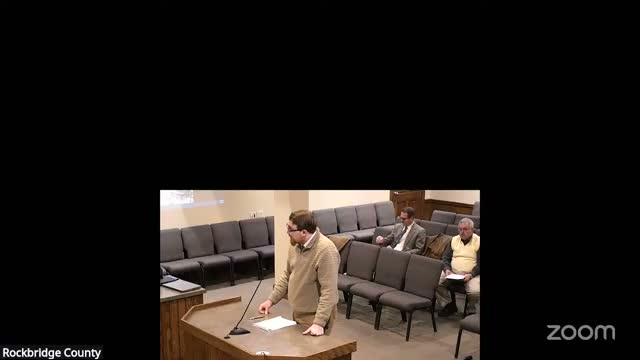
Summary
At a Jan. 28 work session the Rockbridge County Board of Supervisors heard EDA housing subcommittee recommendations to expand targeted R‑2 zoning, allow accessory dwelling units and explore planned unit developments to boost workforce housing near utilities; planners will review the proposals with the planning commission in February.
The Rockbridge County Board of Supervisors on Jan. 28 heard a set of housing recommendations from the Economic Development Authority’s housing subcommittee aimed at increasing workforce housing through targeted R‑2 zoning expansions, new allowances for accessory dwelling units (ADUs) and exploration of planned unit development (PUD) tools.
The recommendations were presented by an EDA representative, who said the EDA’s strategic economic development update and a Central Shenandoah planning district (CSPDC) housing study both concluded that workforce housing availability is a significant constraint to economic growth in the county. "Employers across multiple sectors have indicated that housing availability and affordability directly affect their ability to recruit and retain workers," the presenter said.
Why it matters: The EDA framed the package as a set of practical steps to increase housing types and density in locations already served by public water and sewer. The subcommittee’s 2025 countywide housing survey drew more than 300 responses showing strong demand for homes priced below $350,000 near employment centers. The EDA and staff said limited land with utility service, high land costs and regulatory/development fees make higher‑density building difficult under the county’s current zoning.
What the EDA proposed: The subcommittee recommended three principal approaches: targeted expansion of R‑2 (higher‑density) zoning in surgical locations with existing utilities; consideration of ADUs to increase rental availability; and adoption of a PUD framework to allow mixed‑use and higher‑density projects with community amenities. The presenter also noted the subcommittee examined the potential to facilitate rehabilitation of some unoccupied, substandard housing units in locations with water and sewer capacity but said such activities would face legal and funding limits for the EDA.
Council and staff discussion: Supervisors and staff debated several tradeoffs. One supervisor said recent statistics suggest a vacancy rate of roughly 25 percent that equates to under 600 unoccupied dwellings, about one‑quarter of which are short‑term rentals, and cautioned many vacant units are not presently habitable. Another board member and EDA participants emphasized that density alone does not guarantee affordability: "High‑density does not necessarily mean affordable housing," a supervisor said, warning market‑rate projects can fail to meet workforce needs. The EDA representative urged a mixed approach that includes townhomes, patio homes, multifamily and targeted incentives.
Staff and developer feedback: EDA and planning staff recounted a developer roundtable (10/01/2025) in which contractors identified land prices, limited public water and sewer and fee/permitting costs as the main barriers. Board members discussed the possibility of reducing administrative barriers (for example, fee waivers or targeted incentives) and mapping areas where higher density could be feasible. Unidentified Planner/Staff said national estimates suggest regulatory costs can be substantial: "across The United States, there's roughly $92,000 of regulatory costs in a house," noting that figure is a national average and not specific to Rockbridge County.
Next steps and limits: Staff said they will take the three recommendations (PUDs, ADUs and suggested R‑2 options in utility‑served areas) to the planning commission for review, aiming for a planning commission meeting in February to begin detailed discussion and mapping. The EDA and presenters stressed legal limits: they told the board that under Commonwealth statutes the EDA cannot act as a housing authority that owns and operates rental housing, and that some actions will require separate board or planning commission processes.
Outcome: The board did not take a policy vote on the zoning recommendations at the work session. The meeting recessed briefly for technical reasons and the work session was adjourned by motion; the board recorded affirmative votes to adjourn and said they would reconvene no earlier than 05:35 for the subsequent meeting.
What’s next: Staff will compile comments and questions (via Miss Flint) and schedule follow‑up with the planning commission to review zoning maps, utility service areas and potential fee or permit adjustments to make targeted higher‑density development more feasible.