
Parkrose CFO warns unemployment costs spiking; board approves updated mileage and per diem rates
Get AI-powered insights, summaries, and transcripts
Subscribe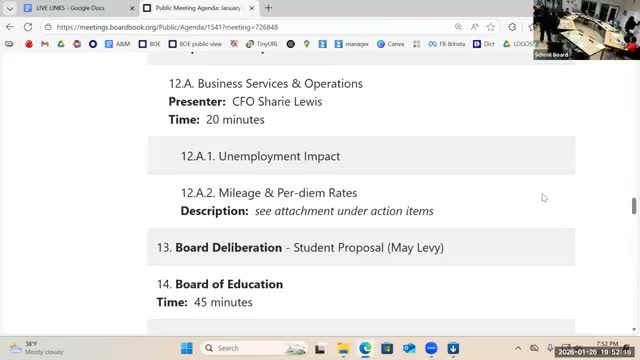
Summary
CFO Sheree Lewis reported unemployment payouts rising from roughly $50,000 to about $80,000 in comparable quarters after a state eligibility change; the board approved updated mileage reimbursement (to $0.725/mile) and affirmed per diem of $86/day.
CFO Sheree Lewis told the Parkrose SD 3 board on Jan. 26 that a recent state change allowing some seasonal employees to claim unemployment during the summer has increased the district’s unemployment payouts.
"Two years ago…we had $50,000 in unemployment. In the first two quarters of this year, we're sitting just under $81,000 for two quarters," the CFO said, noting the district now anticipates unemployment costs to be roughly 80–90% higher than the prior year. She described the district’s approach to paying unemployment invoices as they arise to avoid higher state-assigned rates.
The administration proposed updating the internal travel reimbursement to follow the IRS mileage update; the board approved an increase in the mileage reimbursement rate from $0.70 to $0.725 per mile and confirmed the district’s per diem of $86 per day.
Board members asked whether contract structure or pay timing could mitigate unemployment exposure; the CFO said governmental entities have limited flexibility and that classifying or timing payments would not eliminate eligibility under the new state rule. The board voted to approve the updated reimbursement rates by voice vote during the action-items portion of the meeting.
Next steps: CFO to provide ongoing budget monitoring; board and staff will consider mitigation options but noted legal and contractual constraints on rapid changes to employment classifications.