
Teachers report rising behavior incidents, SPED and staffing strains at Parkrose SD 3; union urges clearer systems
Get AI-powered insights, summaries, and transcripts
Subscribe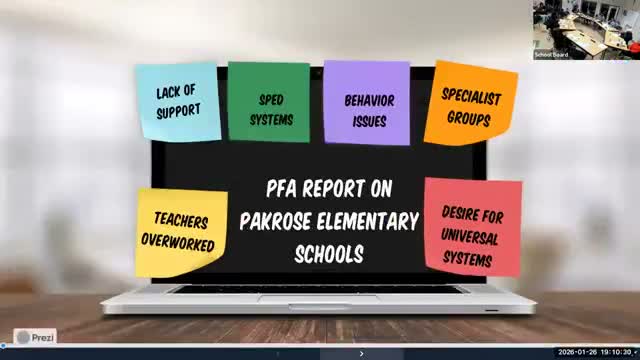
Summary
A PFA vice president told the board that elementary teachers face shortened prep time, frequent behavior incidents (including room clears), shrinking EA support and adversarial SPED communication; board members discussed transparency, universal systems and whether short-term non-budget fixes are possible.
A representative of the Parkrose PFA presented a synthesis of interviews with elementary teachers on Jan. 26, telling the board that teachers at several elementary schools are confronting increased behavior incidents, shrinking support staff and challenges accessing special-education services.
"The first one is that the classroom teachers are guaranteed a 30 minute prep period. Unfortunately, what's being included in this 30 minute prep is them getting their students to and from the class…oftentimes that is not even up to 10 of that 30 minute time," the PFA vice president (Speaker 17) said, describing how routine transitions reduce planning time.
The presenter listed repeated themes raised by teachers: increased behavioral incidents in lower grades, small intervention groups not meeting, educational assistants (EAs) frequently pulled from classrooms, inconsistent behavior plans and slow responses to urgent situations such as room clears. "The fact that that was something that multiple teachers said was a common, possibly weekly occurrence is…worrisome," the presenter said.
The PFA speaker also described friction between classroom teachers and some SPED staff: teachers reported requests for additional supports being denied, while SPED staff said system-level limitations constrain placements and services. The presenter urged improved transparency about how SPED decisions are made and more consistent, districtwide systems so that students transition to middle school with shared expectations.
Board members pressed for specifics and budget context. One director asked whether some improvements could be made without additional money — for example, clearer communication protocols or shared behavior-response practices — and the presenter recommended steps such as bringing staff into conversations earlier and documenting system limits to reduce perceptions of targeting.
Several board members acknowledged the scale of the problem and discussed timing and trade-offs as the district faces an operating deficit. One board member urged more acknowledgement and appreciation for lower-grade teachers, noting that some teachers reported preparing differently to avoid potential student injury. Another member emphasized the need to build stronger relationships between schools and communities.
The board did not adopt policy changes in the meeting; directors asked staff to return with proposals and asked for follow-up at upcoming work sessions.
Next steps: Board and administration agreed to consider nonbudget interventions (communication, transparency, coordination) and to review SPED processes and facility-based supports at a future work session.