Get Full Government Meeting Transcripts, Videos, & Alerts Forever!
Get email alerts on the Budget topic
No spam. Unsubscribe anytime.
Rec & Park forwards two‑year budget to mayor amid debate over golf subsidy and paid parking
Summary
On Feb. 20 the Recreation & Park Commission approved submission of a two‑year departmental budget package that proposes new revenue measures and efficiencies — including a tiered scholarships model, a court reservation fee, golf management RFQs and paid parking in Golden Gate Park — prompting heated public comment about proposed cuts and risks to jobs.
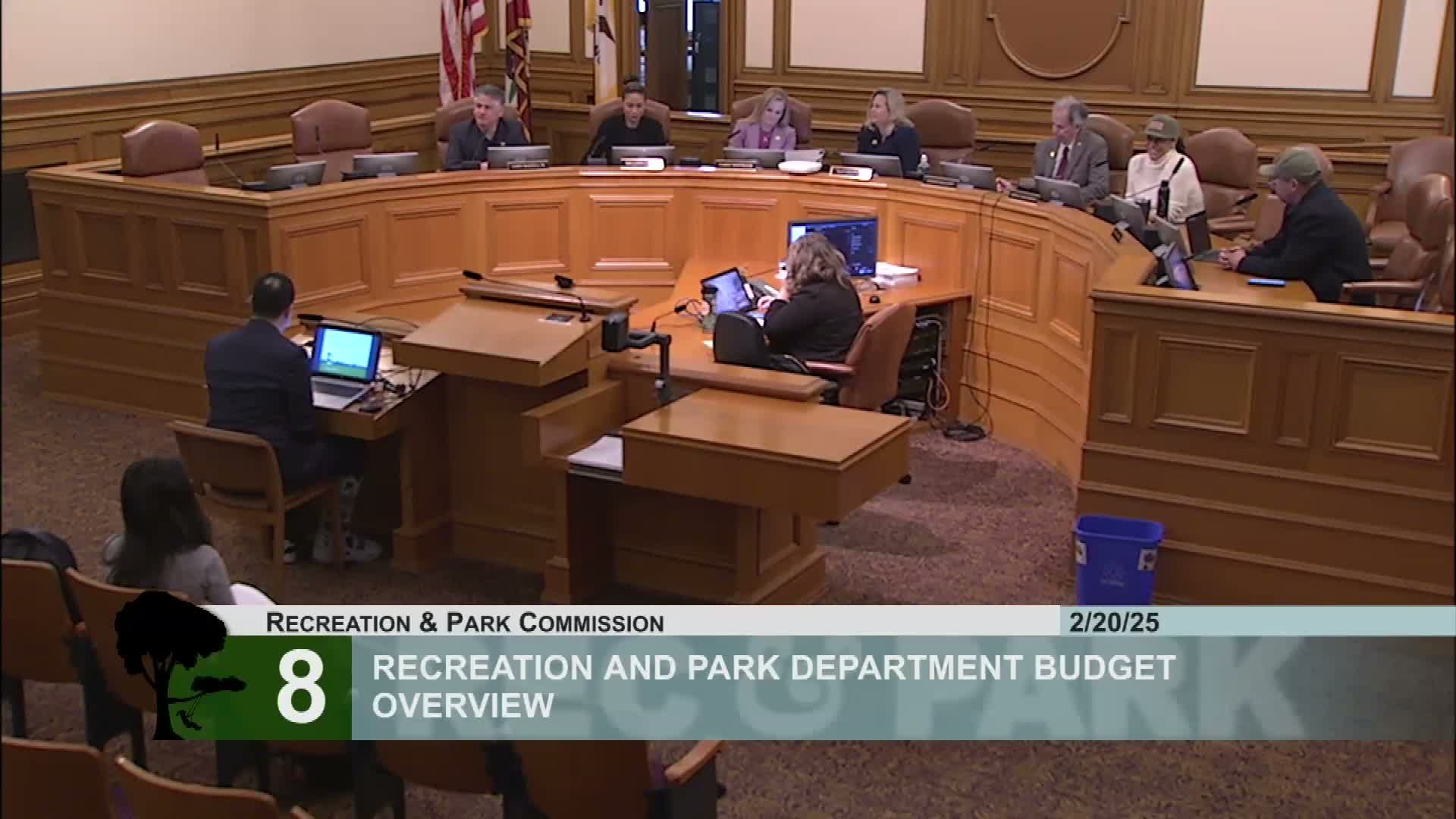
The San Francisco Recreation & Park Commission voted Feb. 20 to forward a proposed two‑year budget to the mayor’s office after a multi-hour presentation and public comment session that centered on potential revenue measures and possible service reductions.
Antonio Guerra, the department’s director of administration and finance, presented the budget, saying staff aim in year 1 to “solve [a] $1,000,000 deficit” while warning that year‑two pressures could be far larger if projected city revenues weaken. Guerra outlined capital requests totaling $15 million in year 1 and $15.5 million in year 2, maintenance staffing plans to support incoming parks (including Treasure Island and Hunters Point Shipyard), and a set of revenue proposals.
Key revenue and efficiency proposals in the packet include codifying the department’s scholarships program with a tiered cost‑recovery model (estimated $600,000 in year 1, $1.2M in year 2), reintroducing a court reservation fee (roughly $1M at $5 per hour), launching RFQ/RFP processes for golf course management with a target of removing roughly $6M in general‑fund subsidy by year 2 if implemented, and beginning paid parking in Golden Gate Park (projected net revenue of $1.2M in year 1 and $9.2M in year 2 in the proposal). Staff also highlighted potential savings from fleet leasing and workers’ compensation reductions.
The budget drew robust public comment. Richard Harris, president of the San Francisco Public Golf Alliance, cautioned that eliminating the $6M golf subsidy “cold turkey” would be unfair and unrealistic without concrete new agreements, urging the department to condition any rollback on demonstrable progress in new management contracts. Skate advocates urged audits of skate facilities and more investment in small‑wheeled access. Several golfers and community groups said they oppose fee hikes without parallel maintenance improvements.
Commissioners pressed staff on details: which golf courses would be affected, the implementation timeline for RFQs, the scope and aesthetics of paid parking in Golden Gate Park, and the budget’s workforce implications. Commissioner Mazzola said she could not “support a budget that has privatizing the golf courses in it,” citing job and union concerns; staff responded that the goal is to avoid layoffs and that privatization is one tool under consideration among many options.
After discussion and public testimony, the commission approved the budget language for submission by the department to the mayor’s office. Staff noted several follow‑up milestones: the city’s joint budget report in March to confirm general fund assumptions, a May 9‑month report that may change projections, and the mayor’s formal budget proposal in June. The department emphasized its intent to continue outreach and policy development on specific items before final implementation.
The approved submission does not itself change fees or contracts; specific fee proposals, RFQs and any contract changes would require separate policy steps and, where applicable, additional public hearings or contractual processes.