Get Full Government Meeting Transcripts, Videos, & Alerts Forever!
Get email alerts on the County Budget topic
No spam. Unsubscribe anytime.
Alamance County commissioners weigh tax hikes, fund‑balance swaps and cuts as budget shortfall looms
Summary
Commissioners debated restoring nonprofit and rescue funding, preserving airport incentives and funding school capital by choosing among manager‑recommended cuts, a 2¢ property tax increase, or dipping into fund balance; staff will provide scenario summaries before Monday's adoption vote.
Alamance County commissioners spent most of a lengthy work session on Monday weighing how to close a projected gap in the manager’s recommended FY2025–26 budget, trading off service cuts against property‑tax increases and one‑time fund‑balance uses.
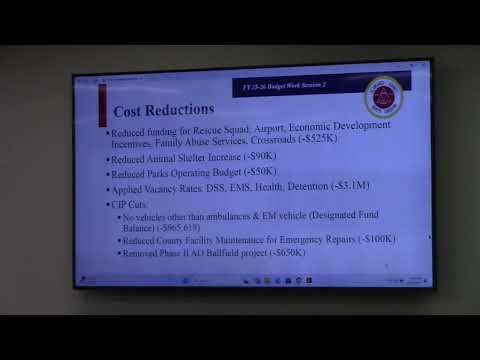
County staff presented a budget that shifts more resources toward mandated services while reducing discretionary programs, saying fully funding all department requests would have required roughly a 6% tax increase. The manager’s recommended package included across‑the‑board trims, a reduced cost‑of‑living adjustment and targeted eliminations of vacant positions to keep a tax increase lower.
The debate centered on three written options the board asked staff to model: keep the manager’s recommendation (minimal or no tax increase); raise the property tax by 2¢ per $100 valuation (estimated to generate about $1.08 million); or appropriate additional fund balance ($4 million–$8 million) for one‑time capital needs and partial restorations. Commissioners also floated a larger tax rate scenario to show the revenue that would be required to fully fund all requests.
Proponents of a tax increase argued that restoring airport incentives, nonprofit grants and rescue squad support — and returning deferred capital projects to the CIP list — would protect economic development and public safety. Opponents said relying on recurring operating costs from fund balance or increasing taxes would create longer‑term structural pressures and urged deeper line‑item cuts and more aggressive vacancy management instead.
Staff briefed the board on the mechanics and risks: using fund balance for one‑time capital is permissible, but recurring reliance would force future budget gaps and could draw scrutiny from the Local Government Commission if unassigned fund balance percentages decline materially. Projected unassigned fund‑balance ratios depend on final audit adjustments; staff’s rough calculation showed that adding $9 million of appropriated fund balance (including $1 million already recommended) could leave an estimated unassigned fund balance in the low‑to‑mid 20% range, but cautioned the figures are preliminary.
Commissioners instructed staff to prepare a concise comparison of four scenarios for Monday’s meeting — the manager’s proposed budget, the manager proposal plus a 1.59¢ rate (the published recommendation), a 2¢ rate, and a larger rate sufficient to fully fund the board‑requested restorations — with clear line items for operating vs. capital impacts and the resulting fund‑balance percentages.
The board also discussed specific restorations recommended by some members: $125,000 for a rescue squad contribution, $75,000–$150,000 in nonprofit support (Crossroads, family services), and restoring some airport incentive funding tied to a multi‑year agreement. Staff said election‑year fee reimbursements could yield miscellaneous revenues (the manager proposed adding $175,000 projected from municipal election reimbursements if received), but cautioned those receipts are cyclic and not guaranteed.
No final votes were taken; the meeting recessed with commissioners agreeing to receive staff’s scenario comparison and to revisit adoption at the scheduled Monday meeting. The board also scheduled follow‑up work to refine impacts on capital projects, the courthouse expansion financing and the 2027 revaluation schedule.