Get Full Government Meeting Transcripts, Videos, & Alerts Forever!
Get email alerts on the Court Operations topic
No spam. Unsubscribe anytime.
Chino Valley magistrate outlines court operations, seeks staffing and security improvements
Summary
Judge Angela Bradshaw Napper told the Chino Valley Town Council the municipal court is expanding caseloads and is implementing security, staffing and technology changes including greater remote appearances and quarterly time‑standard reviews.
Judge Angela Bradshaw Napper on Monday told the Chino Valley Town Council that the municipal court is seeing rising caseloads and is pursuing staffing, security and technology changes to improve timeliness and public access.
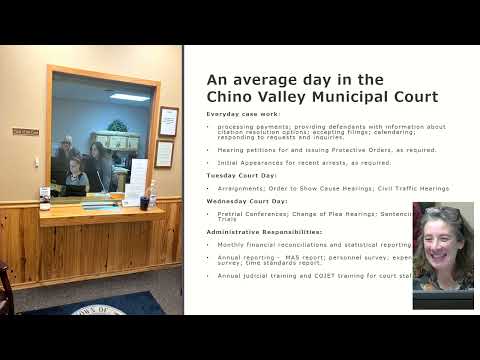
"We are a court of limited jurisdiction," Napper said in an overview of operations that covered case types, staffing levels and technology. She said the court handles criminal misdemeanors, civil traffic offenses and local ordinance violations, and that she has authority to hear protective-order petitions that may originate outside the town. "We're open four days a week from 7 a.m. to 4 p.m.," Napper said, adding she is on-site part time and conducts hearings two days a week.
Napper reported recent caseload figures and a rising trend: "Fiscal year, Chino Valley had 2,217 filings in fiscal year 2025. That was down a little bit to 2,059. We are already on track to outpace both of those numbers for fiscal year 26 with 1,242 case filings from July 1 to December 31," she said, noting most filings are civil traffic matters.
On staffing, Napper identified one full‑time court administrator, Rhonda Apollinar, two full‑time clerks (Elena and Sherry) and one part‑time security officer, and said one part‑time clerk position remains unfilled. "We're going to be advertising to fill that part‑time position," she said, adding that cross‑training would reduce operational risk when staff are absent.
Napper described a recently completed court security assessment and collaborative steps with police, public works, human resources and IT to implement structural and procedural improvements. "My goal is to implement as many of the recommended improvements over the next three years before we're due for that next assessment," she said, and added funding could come from existing security funds or Supreme Court grant programs.
She also said the court is expanding remote appearances through Teams and Zoom for initial appearances and other hearings, describing reduced transport costs and quicker resolutions for defendants who otherwise must travel long distances. "By implementing use of remote appearances ... people are more likely to come for those appearances when they can appear remotely," Napper said.
Council members asked about judicial education requirements and language access. Napper said court staff complete continuing judicial education (COJET) requirements and that the court has one Spanish‑speaking clerk (not a certified interpreter) and contracts a certified Spanish interpreter through the superior court; she added the county recently hired a second interpreter to boost capacity.
Napper closed by stressing impartiality, efficiency and trust: "I am committed to impartiality, fairness, and in an efficient and responsive manner that it meets the needs of the community, ensures the public's trust and confidence in the justice system."