Get Full Government Meeting Transcripts, Videos, & Alerts Forever!
Get email alerts on the Inclusionary Housing topic
No spam. Unsubscribe anytime.
Santa Paula Planning Commission forwards inclusionary-housing updates and a holiday-light exception to City Council
Summary
The Planning Commission voted Oct. 28 to recommend City Council adopt code changes updating inclusionary-housing requirements and amending the light-and-glare section to allow temporary holiday lights while barring strobe or public-safety–hazard lighting; staff and a local task force will refine discretionary language before council review.
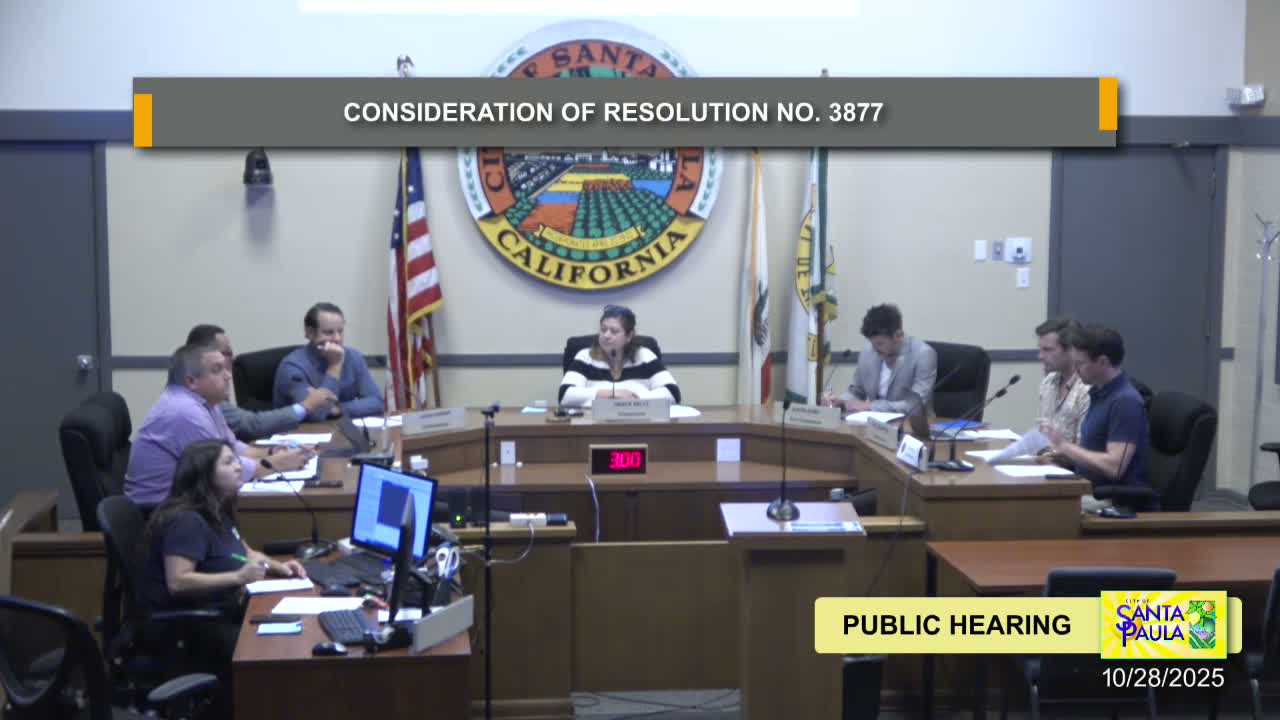
The Santa Paula Planning Commission voted Oct. 28 to forward a package of development-code updates to the City Council, including revisions to the city’s inclusionary-housing rules and an amendment to the light-and-glare code that would permit temporary holiday lighting while prohibiting flashing or strobe patterns that create public-safety risks.
City staff said the items are part of Development Code Update No. 8, a multi-year effort to bring the municipal code into compliance with changing state law and to incorporate community feedback. Staff told the commission the draft change to subsection D of the lighting code would make an exception for "temporary lights used for holiday decorations" and asked commissioners whether to add an explicit time limit — examples discussed included 30, 60 or 90 days.
The distinction matters because subsection D currently bans flickering or flashing lights in residential and commercial zones, requiring lights to remain constant and not change intensity or color more often than once every 30 minutes. Staff and commissioners said the municipality already enforces directed and shielded lighting under subsection F and can address severe or safety-related lighting concerns through nuisance procedures.
"Temporary lights used for holiday decorations" is the current draft language staff said it pulled from comparable city codes, but staff recommended the commission leave the question of an exact duration to further direction. One commissioner argued for flexibility, saying a 90-day allowance in a calendar year can accommodate Halloween, sporting events and winter holidays without intrusive enforcement. Staff cautioned that the city’s enforcement capacity is limited — code enforcement is largely reactive — and said the draft also retains a prohibition on strobes and patterns that could create a public-safety hazard.
On inclusionary housing, representatives of the Santa Paula Affordable Housing Task Force urged the commission to accept the task force’s recommended edits. Gabrielle Vignon, executive director of House Farm Workers, thanked staff and outlined the task force’s membership and work with the city. "We have been able to give some effective input to the general plan, housing element updates, and now the inclusionary ordinance," Vignon said.
Commissioners and staff discussed the use of in-lieu fees when on-site inclusionary units are infeasible. One commissioner cited per-unit construction-cost figures "between $500,000 and $900,000," saying the fee schedule should allow the city manager and council to negotiate a fair per-unit fee that covers the real cost of creating units elsewhere. Staff and task-force members explained the draft recommendation to remove the words "rehabilitation or maintenance" from permitted uses of in-lieu funds: keeping those funds available as a local match can improve competitiveness for state and federal construction grants and encourage the production of new units.
Commissioners reached a consensus to approve staff recommendations and to direct staff to incorporate the task force's suggested revisions before forwarding the ordinance to City Council. Chairperson Kelly moved the resolution recommending that council adopt the ordinance amending chapter 16.13 (inclusionary housing) and section 16.42.05 (light and glare) of Title 16; the motion included a staff-cited exemption from CEQA (transcript reference to "section 15061(b)(3) of the Public Resources Code"). The motion was seconded and approved unanimously.
The commission’s action sends the revised ordinance and the task force’s additional edits to the City Council for consideration; staff said the next development-code update is scheduled for the commission’s combined November/December meeting on Dec. 9, when the council may consider the packet forwarded from the commission.