Get Full Government Meeting Transcripts, Videos, & Alerts Forever!
Get email alerts on the Lead Service Line Inspections topic
No spam. Unsubscribe anytime.
Panel tables bill to streamline lead‑service‑line inspections amid privacy and notice concerns
Summary
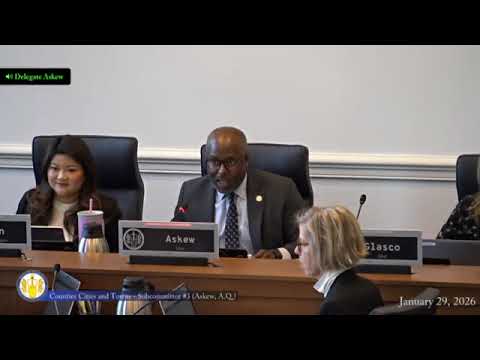
HB 1149 would ease federally required service-line inspections under the EPA Lead and Copper Rule by allowing utility inspectors limited exterior access to determine pipe materials; proponents called it a necessary public-health efficiency, while members raised notice and privacy concerns. The committee tabled the bill 6‑0 for further drafting.
Doug Hodge, speaking for the Virginia Municipal Drinking Water Association, said HB 1149 is narrowly drawn to let water-system inspectors access exterior areas of a customer's property to inspect service-line material (lead, galvanized, or non‑lead) for compliance with the EPA's Lead and Copper Rule. He told the committee inventories are due by Nov. 1, 2027, and that hundreds of thousands of service lines remain classed as "unknown."
"This is about public health, lead removal, equity," Preston Bryant of Fairfax Water and other water-system representatives told the subcommittee, describing the current paper consent process as slow with low return rates. They said a small, exterior pot-hole inspection is typically sufficient to identify the service-line material and that records and customer notices would be maintained.
Members raised questions about privacy, a clear notification standard and whether a simple notice period should be required before entry. The utility side suggested a short-notice amendment (e.g., 14 days) could address concerns, but members wanted additional refinement.
After debate, the committee voted 6‑0 in favor of tabling HB 1149 to allow further work to add clearer notice requirements and technical fixes to the substitute language.