
Subcommittee advances solar-siting bill with substitute emphasizing standards, data collection and local authority
Get AI-powered insights, summaries, and transcripts
Subscribe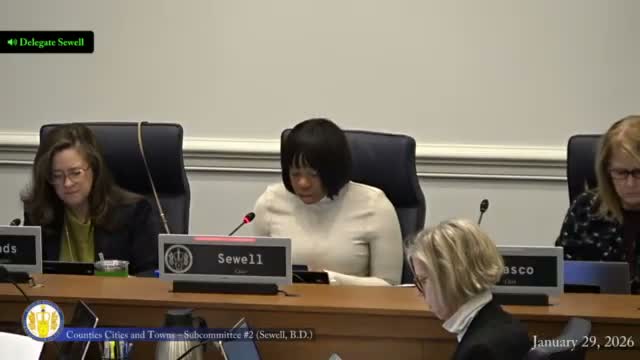
Summary
A House subcommittee reported a substitute for HB 711 to set statewide standards for solar projects while preserving local authority; supporters said it will speed sensible projects, while counties and environmental groups warned against a one-size-fits-all approach. The measure was reported by the committee.
Richmond — The House subcommittee reported a substituted version of House Bill 711 on Jan. 30 after a session of testimony and questions about statewide solar siting standards.
Leader Herring, the bill’s sponsor, told the panel the measure aims to "provide clear and consistent guidelines for solar projects statewide while preserving local autonomy." He said the substitute clarifies decommissioning rules, strengthens wetland buffers consistent with the Chesapeake Bay Protection Act, refines grading and erosion-control language and requires collection of data on local project denials. "Failure to do so will result in Virginia being forced to rely on fossil fuels and the need to build seven new natural gas plants and associated pipelines over the next 15 years," Herring said.
Supporters from the renewable-energy and environmental communities described the bill as a practical step to increase solar development while protecting communities. Sarah Graham Taylor of Merrick Action and Evan Vaughn of the Mid Atlantic Renewable Energy Coalition both urged the subcommittee to pass the substitute, saying it would accelerate deployment "while retaining local control." Industry representatives, including the American Clean Power Association, also testified in favor.
Local and conservation groups cautioned that a uniform statutory approach may not suit all local circumstances. Joe Lurch of the Virginia Association of Counties said the substitute risks prescribing a "one-size-fits-all" framework across projects that vary widely in scale and geography. Dan Holmes of the Piedmont Environmental Council said best-management standards should be developed by state agencies engaging all stakeholders rather than being set largely in statute.
The substitute was moved and seconded in committee and was reported out of the subcommittee for further consideration. The record shows a committee action to report the substitute, but no roll-call tally was provided in the transcript record for this item.
What’s next: The bill now proceeds in the legislative process with the committee substitute as the subcommittee reported it. Additional committee or floor action may follow as members and stakeholders weigh technical details about buffers, decommissioning cost calculations and data collection on denials.