
Committee backs bill letting utilities securitize prudently incurred storm costs; amendment extends PUC review window
Get AI-powered insights, summaries, and transcripts
Subscribe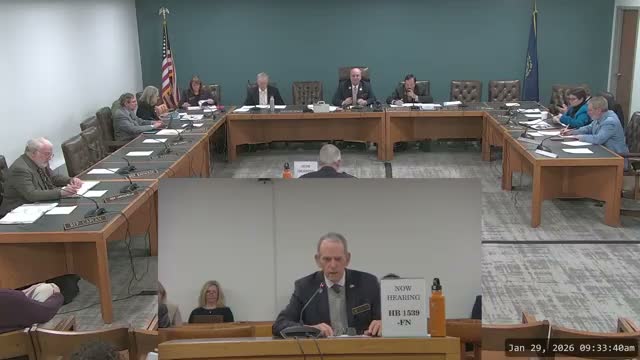
Summary
The Science, Technology and Energy Committee advanced HB 15‑39, which would let utilities securitize PUC‑approved storm recovery costs to spread payments over decades. Supporters say it reduces near‑term bill shocks; critics and state agencies warned about administrative costs and oversight resources.
Representative Michael Vose introduced HB 15‑39, saying the bill would add prudently incurred storm recovery costs to RSA 369‑B and allow the Public Utilities Commission to approve securitization — the issuance of AAA‑rated, rate‑reduction bonds — so utilities could spread repayment over bond terms and reduce immediate bill impacts.
Supporters argued securitization is an established regulatory tool. Mark Brown of the Consumer Energy Alliance pointed to examples in other states where securitization reduced customer costs, and Eversource’s Michael Licata told the committee New Hampshire has used securitization before and that recent storm seasons produced very large costs: the company recorded a $113,000,000 response cost for its April 2024 heavy wet‑snow event and roughly $450,000,000 in total storm response between 2022 and 2024. “The purpose of securitization is to lower bill impacts for customers of significant events,” Licata said.
Members pressed how often securitization would be used and who bears administrative costs. Representative Harrington and others raised a recurring scenario: if DOE or the PUC must hire consultants to review a utility filing and later reject the petition, those consultant costs would be assessed to the petitioning utility and could be passed along to ratepayers. Meg Stone of the New Hampshire Department of Energy said the department is neutral and expects to need consultants to analyze filings, estimating $250,000–$650,000 per review (assessed to the petitioning utility), and she cautioned that a 60‑day PUC deadline would be difficult to meet.
Eversource’s Licata acknowledged the 60‑day window was short and said the company would be amenable to flexibility. He also reminded the committee that an existing storm fund — about $19,000,000 collected through distribution rates — is applied first, and securitization is intended to address costs far larger than that fund can cover.
After public testimony from labor and business groups supporting the bill and from ratepayer advocates seeking stronger consumer protections, the committee moved HB 15‑39 into executive session. Members adopted Amendment 0409H to change the PUC decision timeline from 60 days to a period not to exceed 180 days and then voted to report HB 15‑39 Ought to Pass as amended by a 15–0 roll call. The amendment and vote were taken in executive session.
What happens next: HB 15‑39, as amended, will go to the House calendar (not the consent calendar because of a fiscal note). If it becomes law, utilities would still need separate PUC approval for any securitization; the PUC would determine which storm costs it finds prudently incurred and whether securitization is in the public interest.