
Commission issues determination for paving Springfield track in wetland buffer; staff to inspect before work
Get AI-powered insights, summaries, and transcripts
Subscribe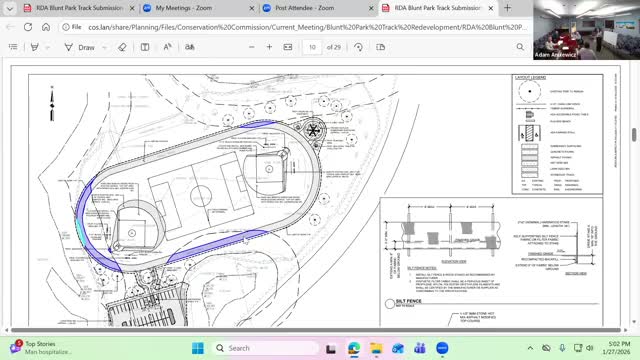
Summary
The Springfield City Commission issued a determination permitting the city to pave an existing stone-dust quarter-mile track within the current footprint, despite portions falling inside the city's 50-foot and 100-foot wetland buffers; commissioners required a staff site inspection before construction.
Stephanie McDowell, representing Springfield City, told the commission the city is asking to pave an existing gravel and stone-dust quarter-mile track at Bud Park (the transcript also refers to it as "Blood Park"). "We would like to propose to pave it," McDowell said, describing a half-inch asphalt top course over a half-inch binder to be installed within the current footprint.
McDowell said a small area—about 225 square feet—lies inside the city's 50-foot "no disturb" buffer and that just under about 7,500 square feet lies within the city's 100-foot wetland setback. She described environmental and maintenance benefits, including easier winter clearing compared with the existing gravel surface.
Commissioners pressed for details on footprint, widening, and protections for nearby wetlands. McDowell said the project would not widen the track and that silt (soap) fence and a limit-of-work line have been used on prior phases and would be maintained or reevaluated before paving. "We came out before," she said, describing erosion-control measures.
Several commissioners debated whether the existing compacted stone-dust should be treated as effectively impervious; one commissioner said paving will increase impervious surface but argued "the public benefit outweighs" runoff concerns given the track's narrow width (speakers estimated 6–10 feet). Another participant said loose stones currently wash into adjacent wetland areas and that pavement could reduce stone migration: "the macadam actually, in this case ... is probably better than the compacted stones."
After discussion, a motion passed to close the public hearing. The commission then voted to "issue a determination that it is applicable but does not require refinement," recording affirmative votes. Commissioners also instructed that staff (referred to as Adam in the transcript) visit the site before work begins to confirm limits of disturbance and erosion controls.
The determination authorizes paving within the existing footprint but does not waive the city's wetland buffer rules; commissioners conditioned progress on a preconstruction site inspection and on maintaining or updating erosion controls as needed.