
District committee recommends limiting student smartphone use during instructional time
Get AI-powered insights, summaries, and transcripts
Subscribe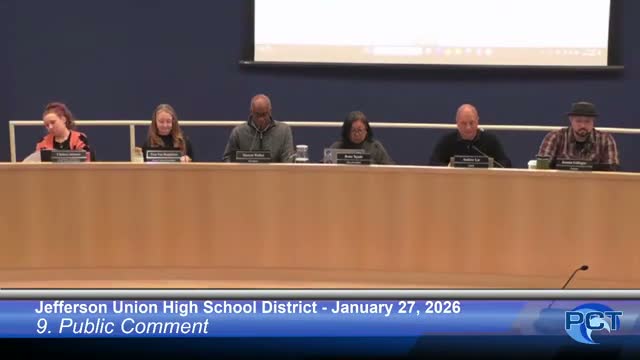
Summary
A committee convened under AB 32 16 recommended that the Jefferson Union High School District require students to turn off and put away smartphones during instructional time, encourage individual schools to consider bell-to-bell bans, and return a redline of proposed policy language at the next meeting.
A committee formed to respond to AB 32 16 presented its findings to the Jefferson Union High School District board and recommended that smartphones be turned off and put away during instructional time, rather than immediately imposing a district-wide bell-to-bell ban.
The recommendation, delivered by committee co-chairs and site leaders, followed a year of meetings, a districtwide survey and a review of peer research linking stricter phone policies to improved classroom outcomes. The committee reported it included representatives from Jefferson, Oceana, Westmore and Thornton high schools and that staff responses generally favored stricter rules while students were less supportive: the committee said roughly 4% of responding students favored a full bell-to-bell ban.
Why it matters: AB 32 16 requires districts to adopt policies limiting or prohibiting student phone use by July 1, 2026. The committee’s draft redline — not included in the meeting packet — will be posted for board review at the next meeting; if accepted, the policy would return for placement on the consent calendar for action.
What the committee proposed and why: The committee’s recommendation would add explicit language saying smartphones and similar devices must be turned off and put away during instructional time and clarifies the statute’s four exemption categories, including emergencies and IEP accommodations. The committee told the board that while it believes a bell-to-bell ban is “best for students” in many settings, it stopped short of recommending a single district mandate and instead urged site-level discretion so schools could choose implementation models (for example, backpacks, wall pouches or Yonder-type storage systems).
Implementation issues and student experience: The board heard details from Terra Nova’s pilot of Yonder pouches, including unlocking stations and portable unlocking devices for emergencies. Terra Nova staff described improved student focus but also acknowledged breakage, students attempting workarounds and initial resistance. Board members and student speakers raised concerns about equitable access to translators and access for students whose IEPs require device use; the committee said those situations are already covered by IEP and medical exemptions.
Funding and next steps: Trustees asked whether the district or individual schools would cover the cost of pouch systems; staff said that if the board directs a district recommendation, the district would ensure schools have what they need and would cover costs associated with district-level implementation, but cautioned that funds are limited and would be prioritized against other needs.
Trustee questions and data requests: Several trustees expressed support for the committee’s recommendation but asked for more recent, disaggregated outcome data before any districtwide mandate. One trustee cited school-level figures presented verbally showing a drop in ninth‑grade failure rates from about 29.4% to 6.89% after implementation at a site; board members asked staff to return updated data to verify and contextualize those claims.
What happens next: The committee will provide the redlined policy language in the next meeting packet for board review and discussion. The board may then place the finalized policy on a future consent agenda for formal action.
"We do feel a bell to bell ban is what's best for students," the committee said, while recommending the district policy require phones be put away during instructional minutes and allow sites to explore stricter site-level approaches.