Council adopts revised 'good neighbor' warehouse rules under state AB 98; 4–3 vote
Loading...
Summary
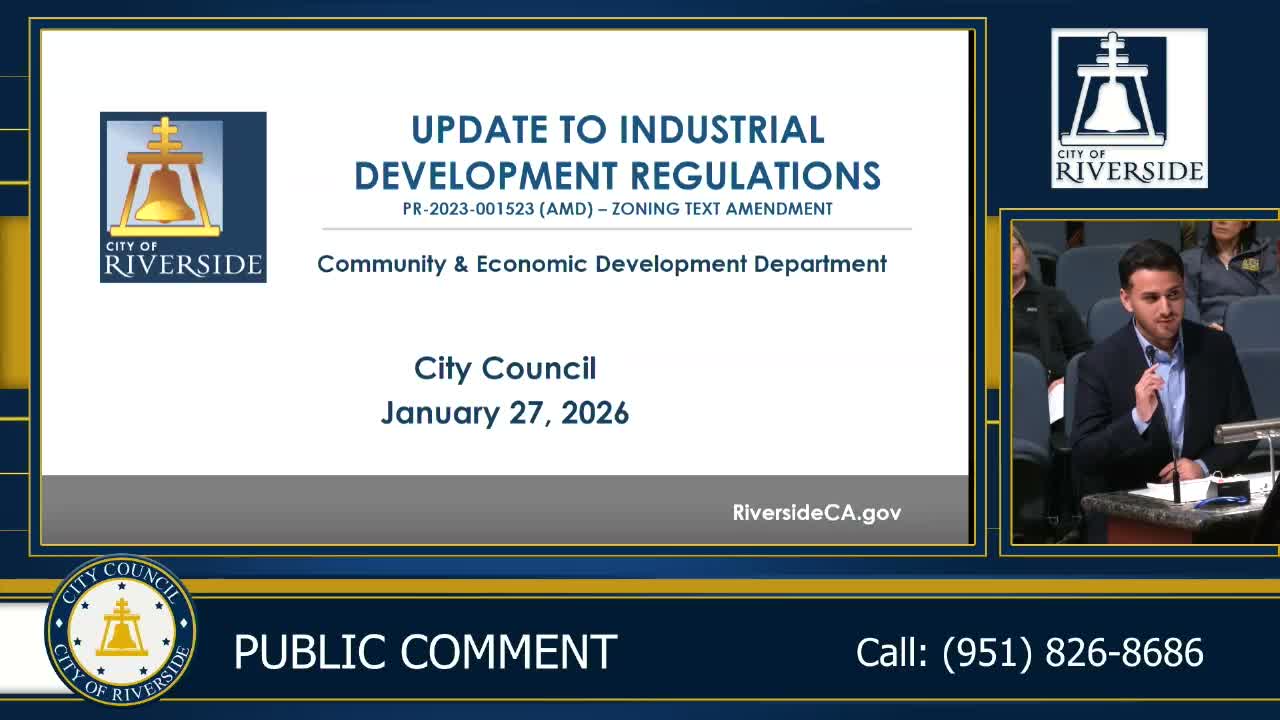
After extensive public testimony for and against stricter limits on logistics development, the Riverside City Council adopted, 4–3, a municipal code amendment implementing AB 98 baseline requirements, updated public‑notice rules, truck‑route planning and limits on very large warehouses (≥400,000 sq ft outside General Industrial), with a council request to review the ordinance in one year.
The Riverside City Council on Jan. 27 adopted municipal-code amendments addressing warehousing and logistics uses — implementing AB 98 baseline requirements, expanding public‑notice for warehouse projects, and restricting certain very large logistics facilities outside the General Industrial zone.
Planning staff explained the ordinance would define logistics/warehousing consistent with state law, identify ‘‘sensitive receptors’’ for proximity‑based standards, require staff to establish truck routes consistent with AB 98, and increase the notification radius for discretionary warehouse projects to 1,000 feet (from 300 feet). The ordinance also prohibits warehouses of 400,000 square feet or greater in most industrial zones except General Industrial and limits cumulative warehouse floor area on parcels near sensitive receptors.
Public testimony was lengthy and sharply split. Residents and environmental and neighborhood groups argued the changes were long overdue, citing air quality and traffic impacts; Sandy Cabrera called for stronger protections and said Riverside already experiences poor air days. ‘‘Please stop these massive warehouse projects that are destroying our community,’’ she said. Business‑ and industry‑aligned speakers — including the local chapter of NAIOP and carpenters’ union representatives — warned the rules could limit jobs, deter investment and function as a de facto moratorium on large industrial projects.
Council members debated the balance between preserving economic development flexibility and protecting community quality of life. Supporters said the ordinance threads a careful needle: it limits logistics footprint near homes while leaving other industrial uses and modernization options intact. Opponents said the cumulative floor‑area limits and a 400,000‑square‑foot threshold would sharply constrain where large users could build.
The measure passed 4–3. The council amended the motion to ask staff to return in one year to review how the rules are working and to revisit class‑action wording in the appointments language adopted earlier in the meeting. Staff will continue truck‑route outreach and bring truck‑route maps to the council later this year.