Get Full Government Meeting Transcripts, Videos, & Alerts Forever!
Get email alerts on the Local Revenue Measures topic
No spam. Unsubscribe anytime.
Riverside staff outlines five ballot revenue options; council asks staff to return with language
Summary
City staff presented five options for raising local revenue — a quarter‑cent sales tax, an extension of Measure Z, a transient occupancy tax increase, combinations, or no action — and highlighted a March 6 deadline for June ballot placement; council asked staff to bring all five options back for possible action on Feb. 24.
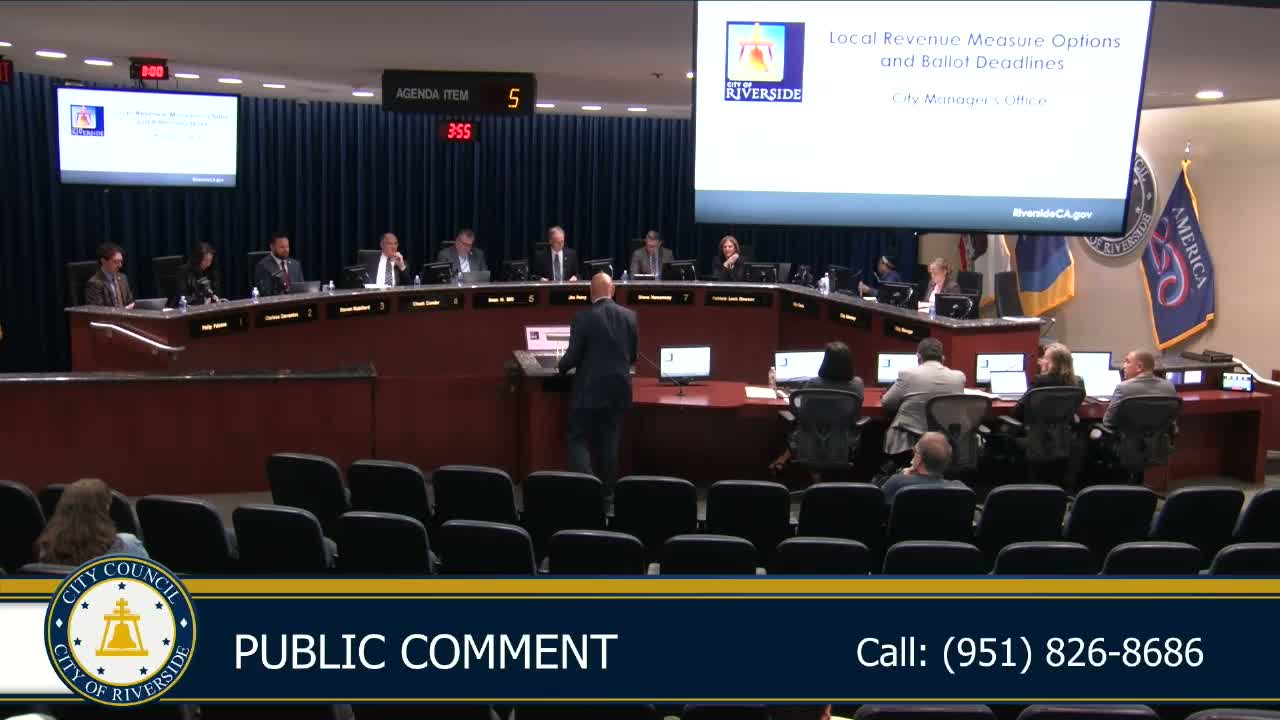
City Manager Mike Futrell and Assistant City Manager/CFO Edward Enriquez briefed the Riverside City Council on Jan. 27 on potential local revenue measures and statutory deadlines for the June 2, 2026 primary.
Futrell said the presentation was a workshop and not a request to place a measure on the ballot tonight. He described the options as tools to address long‑term fiscal needs, noting particular shortfalls in public‑safety staffing and long‑term capital needs. ‘‘In terms of our budget and the need for revenue, our current budget as it exists is a strong budget. But I think there are some unmet needs particularly in the fire department,’’ he said.
Enriquez presented five choices: a quarter‑cent (0.25%) sales tax increase (estimated at roughly $21 million annually), extension of Measure Z (a 1% transaction/use tax that sunsets in 2036), a one‑point transient‑occupancy tax (TOT) increase (estimated $640,000 per 1% annually, with larger gains if new hotel rooms come online), a combination of measures, or no action. He highlighted the statutory filing deadline for a June ballot (the city must file a resolution by March 6).
Council members discussed tradeoffs between near‑term affordability concerns and longer‑term public‑safety and infrastructure needs. Several members said they would support staff returning with language and analyses on all options and noted that voters ultimately decide such measures. Nicholas Adcock of the Greater Riverside Chambers of Commerce said his organization had no formal position but encouraged careful analysis and public outreach.
Council direction and next steps: a majority of council members asked staff to return with ballot language, fiscal analysis and community engagement plans for all five options and to bring an item for potential vote on Feb. 24, allowing the council to meet statutory timelines if it chooses to place a measure on the June ballot.