Get Full Government Meeting Transcripts, Videos, & Alerts Forever!
Get email alerts on the Homelessness topic
No spam. Unsubscribe anytime.
Riverside council authorizes Homekey application to convert University Avenue Quality Inn into 114 supportive housing units, with conditions
Summary
The City Council authorized staff to submit a joint Homekey application with Riverside Housing Development Corporation for up to $35 million to convert the Quality Inn at 1590 University Avenue into 114 studio units (94 permanent supportive housing, 20 affordable). The council required final award acceptance, appropriation and key operational details return for council approval.
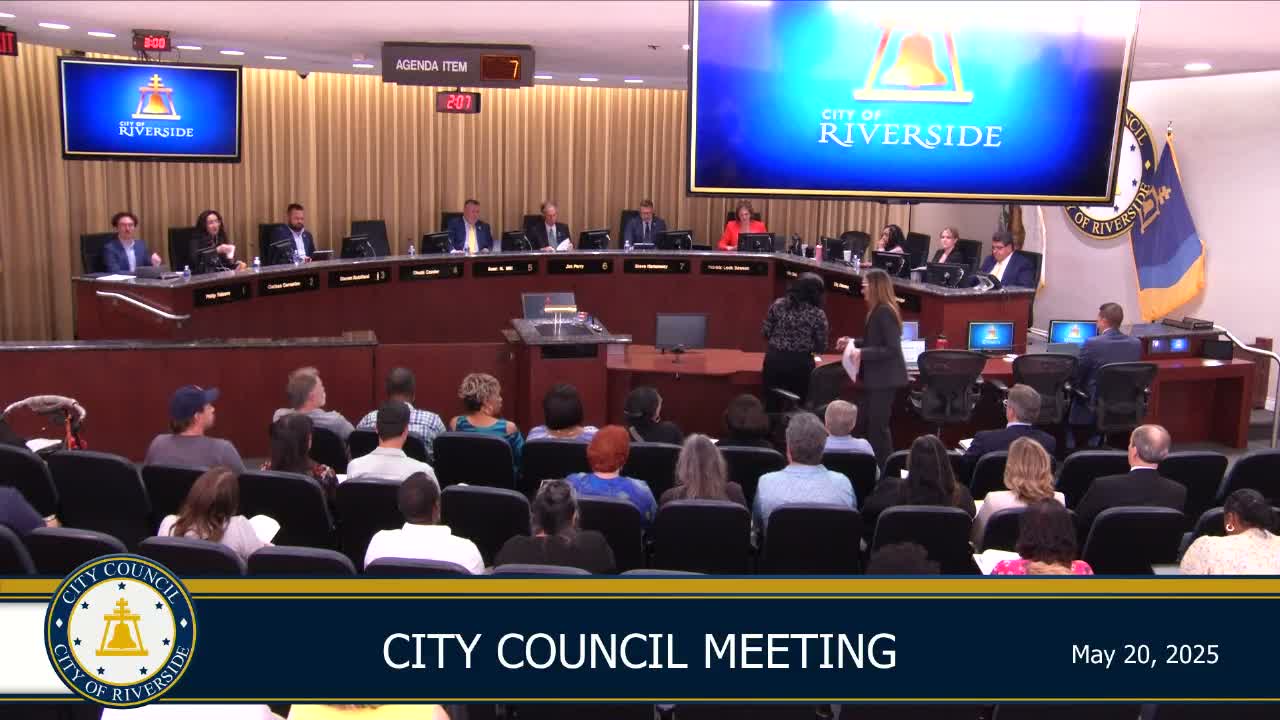
The Riverside City Council on May 20 authorized staff to submit a joint application to California’s Homekey program seeking up to $35 million to acquire and convert the Quality Inn at 1590 University Avenue into 114 studio units, including 94 permanent supportive housing (PSH) units paired with case management and 20 affordable units.
Housing and Human Services Director Michelle Davis told the council the project — proposed by Riverside Housing Development Corporation (RHDC) and to be branded “University Terrace Homes” — would reserve 94 Homekey Plus units for households at or below 30 percent of area median income and 20 units at or below 50 percent of AMI, with a 55‑year affordability period. “The proposed project I’m presenting today is not an emergency shelter and it is not inclusionary housing,” Davis said during her presentation.
The proposal asks Homekey for acquisition, rehabilitation and up to 10 years of operating support. City staff described an operating model with on‑site management and security, four full‑time case managers (CityNet plus one city case manager), and a collaboration of local nonprofit partners to provide services and job training. RHDC’s estimated development cost for the adaptive reuse was presented at roughly $26.7 million.
Public comment stretched for hours. Supporters — including local affordable‑housing advocates, service providers, and union representatives — said the city needs immediate PSH to reduce street homelessness and stabilize seniors and veterans. Opponents, including several University Avenue business owners and the Greater Riverside Chambers of Commerce, said outreach to the business community was insufficient and warned of long‑term corridor impacts.
Council members debated outreach, service levels and fiscal risk. Councilmember Clarissa Cervantes, who led the motion to proceed, said she had pushed for the item because many residents were waiting for housing: “My soul aches… I’ve had to fight now for 4 weeks to fight for something that should be so easy,” she said. Other council members pressed staff for clearer commitments on case management, infrastructure (including building plumbing/sewer capacity), and a plan for operations after the Homekey operating support expires.
The council approved the motion to submit the application and authorized city staff to execute necessary application documents, with a binding caveat: if the city is awarded Homekey funds, council acceptance of the award, appropriation of funds, and execution of final grant agreements must return to the full council for final approval. Council directions also included: stronger community outreach, additional due diligence on site infrastructure and sewer impacts, documentation of RHDC’s cost estimates, and an expectation staff will pursue additional operational funding sources when available.
RHDC’s CEO Bruce Culpa (present in chambers) said RHDC would serve as developer, owner and operator and emphasized RHDC’s local footprint and experience in Riverside affordable housing.
Next steps: staff will submit the Homekey application by the state deadline and, if the city is awarded funds, return to the council with the full grant agreement, final budgets, and the staff report required by the conditional direction the council attached.
Outcome and next step: Council authorized the application for up to $35 million with the requirement that acceptance of any award and appropriations return to the council for approval and additional due diligence.