Get Full Government Meeting Transcripts, Videos, & Alerts Forever!
Get email alerts on the Zoning And Land Use topic
No spam. Unsubscribe anytime.
Douglas County launches six-month diagnostic review of zoning and subdivision regulations
Summary
Consultants from Lehi/Clarion presented a six-month diagnostic to identify strengths, gaps and modernization opportunities in Douglas County's zoning and subdivision regulations; commissioners pressed for public engagement and clarity on how the review will relate to Plan 2040.
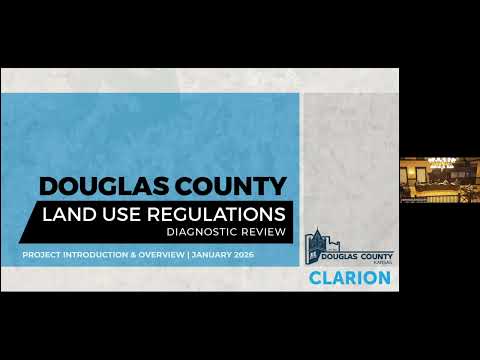
Elizabeth Garvin, a planning consultant who said she is with Lehi and Associates, told the Douglas County Board of Commissioners on Jan. 28 that the county has launched a six-month diagnostic review of its zoning ordinance and subdivision regulations to identify strengths, gaps and opportunities to modernize code language.
The review team described the work as an issue-identification phase that will produce an "issues list" for staff, the planning commission and the board, followed by a public draft and an opportunity for community comment. "So Clarion Associates is a land use planning firm out of Denver and Chapel Hill," Garvin said, explaining the firm's experience and adoption record. The consultants said the diagnostic typically results in a readable 40-to-60-page report outlining issues and a set of options the county can choose to pursue.
Commissioners sought clarity on sequencing and public involvement. "Meant to inform, but I do feel that constituent should be included in the first pass," Commissioner Krishna Kelly said, urging earlier listening sessions rather than waiting until a public draft is released. Consultants said their starting point is internal conversations with staff and frequent code users and that public outreach generally ramps up after an issues list is available, but they said they would incorporate more outreach if the board requested it.
The board and consultants discussed how the diagnostic will relate to Plan 2040 and local sector plans. The consultants said they would not set policy; instead, they said they would outline alternative regulatory approaches tied to different policy directions and return to the commission when policy choices are needed. "We can do this in the code, but this is a policy choice, and so we hand those back up in your direction," Garvin told commissioners.
Members of the public urged more accessible engagement methods. Tim Hamilton, a resident who addressed the meeting in person, said the county should allow visual aids for public commenters to ensure effective public speech. Other speakers, including Patrick Ross and Dominique, called for clear comparisons between county and city regulations, more in-person listening sessions, and early opportunities for public questions on drafts.
Next steps: consultants said they will prepare an issues list from internal interviews with staff and technical stakeholders, present that list to the planning commission and county commission, and then post a public draft for comment with multiple channels for input. The consultants indicated an anticipated presentation later in the year for further deliberation.
The presentation was for information only and no policy changes or votes on code updates were taken at the meeting.