Get Full Government Meeting Transcripts, Videos, & Alerts Forever!
Get email alerts on the Encampment Dma topic
No spam. Unsubscribe anytime.
Riverside approves pilot agreement with Caltrans to clear freeway‑ramp encampments
Summary
The City Council unanimously approved a two‑year pilot Encampment Delegated Maintenance Agreement with Caltrans District 8 that lets Riverside conduct targeted cleanups and outreach on state freeway ramps, with reimbursement up to $50,000 per quarter during the pilot.
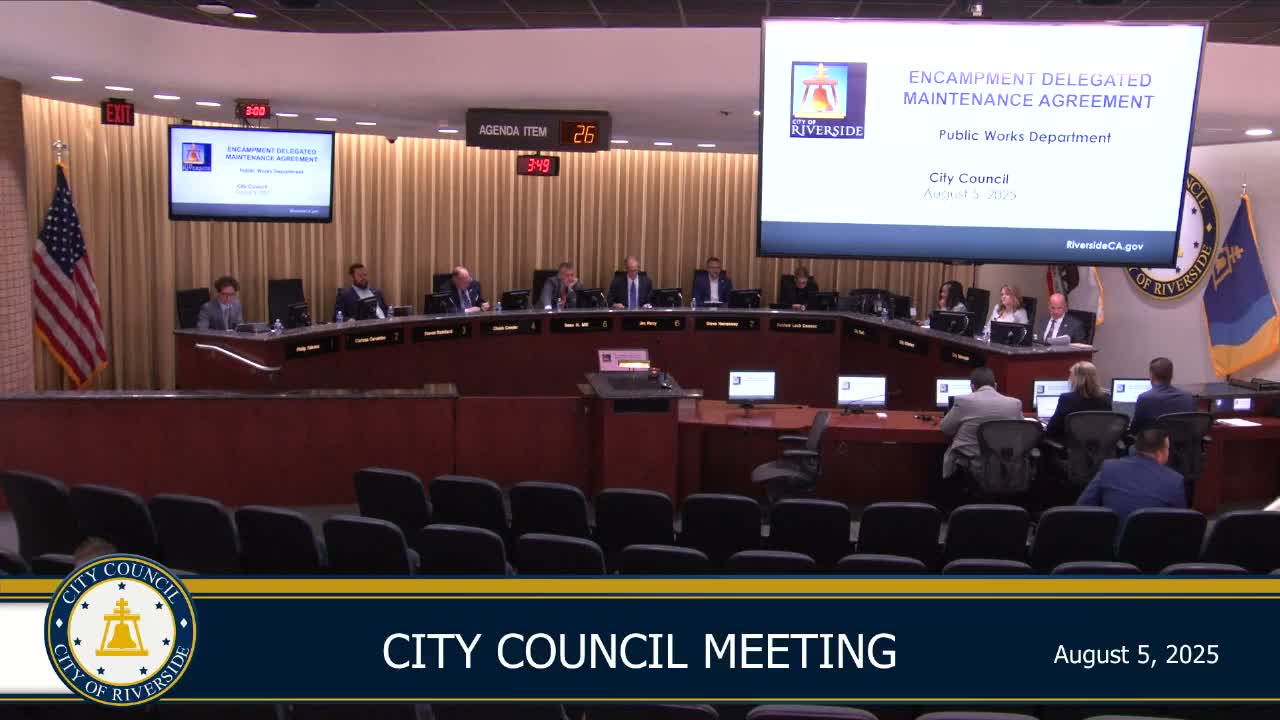
Riverside’s City Council on Aug. 5 voted unanimously to approve a pilot Encampment Delegated Maintenance Agreement (DMA) with Caltrans District 8 that will let the city perform and be reimbursed for targeted cleanups and outreach on state freeway ramps within city limits.
The agreement, pitched by Deputy Public Works Director Nathan Mustafa and housing partner Socorro Gomez, creates a framework for the city’s outreach-and-cleanup team to operate in Caltrans right‑of‑way. Mustafa said the pilot runs through June 30, 2027, and the state will reimburse the city up to $50,000 per quarter — a total of up to $400,000 over the pilot term — for eligible work.
Councilmember Adam Mill called the agreement “a win for the taxpayers of Riverside,” saying quicker local response times will improve public health, safety and the city’s appearance at freeway gateways. “This is gonna make it a lot easier to get there,” Mill said, and urged rapid use of the tool in hot‑spot locations.
Councilmembers pressed staff on operational details: how Caltrans will classify encampment priority levels, what notification periods will apply before outreach or removals, whether a blanket encroachment permit will allow rapid response, and how rapidly the pilot funds might be exhausted. Mustafa and Gomez said the DMA is a Sacramento‑approved framework that will be followed by a locally negotiated standard operating procedure to set timelines, notification and coordination protocols.
Mustafa said the intent is not to supplant Caltrans’ responsibilities but to expand local capacity where state resources are thin. He added that the city will use an existing outreach contractor roster and that staff will prioritize known “hot spots” so the limited pilot funds are used strategically.
Mayor Patricia Slack Dawson and other council members thanked state and governor’s office staff for moving the agreement through Sacramento. Councilmember Jim Perry asked staff to provide firm expectations about notification periods and priority categories so residents understand what the pilot will (and will not) deliver.
The council’s action authorizes the city manager to execute the DMA, permits minor non‑substantive changes, and delegates the CFO to record the necessary revenue increases and appropriations. Staff will report pilot outcomes and discuss funding and operational adjustments as the project proceeds.