Get Full Government Meeting Transcripts, Videos, & Alerts Forever!
Get email alerts on the Public Safety Immigration Transparency topic
No spam. Unsubscribe anytime.
Riverside City Council adopts revised ‘Safe Communities’ resolution after hours of public testimony
Summary
The Riverside City Council voted 4-3 to adopt a revised resolution that urges federal immigration personnel to identify themselves, affirms that city services should be available regardless of immigration status, and directs staff to expand community education and monthly reporting after extensive public comment largely in favor.
The Riverside City Council voted 4-3 on Oct. 14 to adopt a revised “Safe Communities” resolution intended to increase local transparency around federal immigration enforcement and to reassure residents that city services remain available to all regardless of immigration status. The motion passed after more than two hours of public comment and a series of council remarks about legal limits and practical next steps.
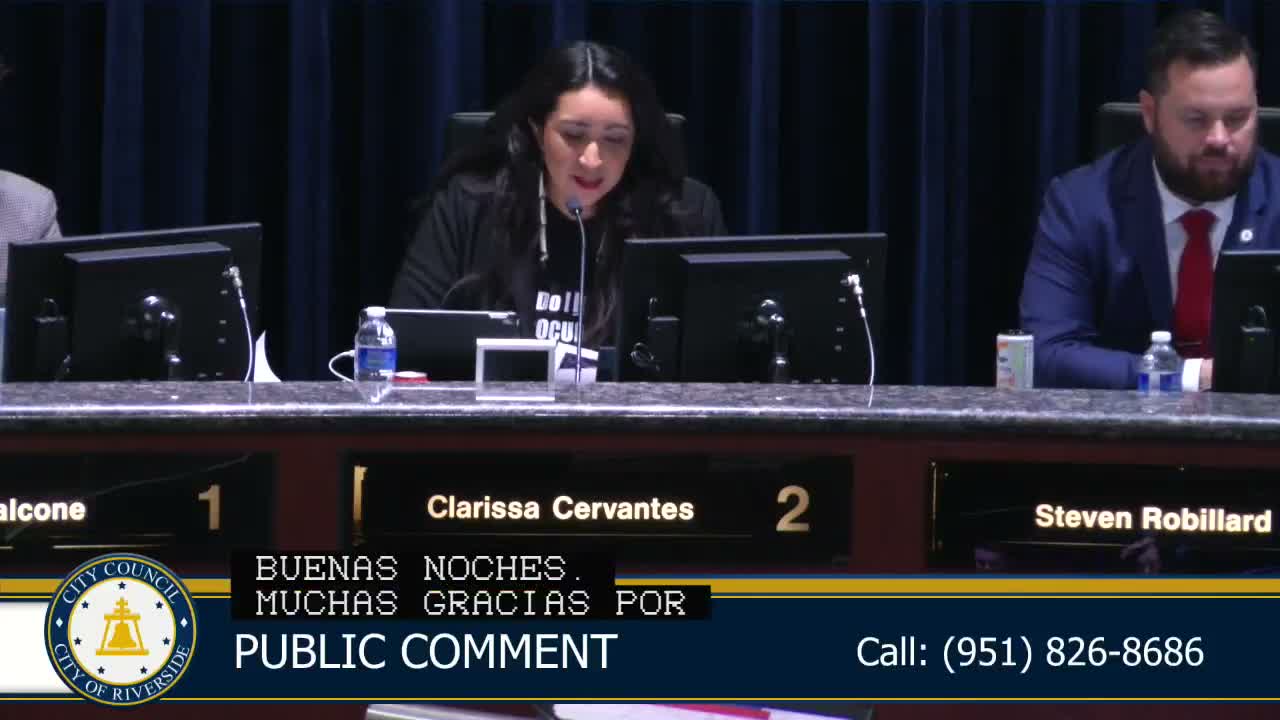
Councilmember Clarissa Cervantes introduced the proposal as a local reaffirmation of the city’s values and a set of actions the city can take to protect residents. “La ciudad de Riverside reafirma el compromiso asegurándose que todos los residentes, a pesar de su estatus de migración, pueden acceder su los servicios de la ciudad sin y sentirse seguros en la comunidad,” Cervantes said during a slide-assisted presentation outlining sections that ask federal personnel to use clearly marked vehicles, identify themselves when operating inside city limits, and for the city to provide monthly reporting to the Human Relations Commission.
The resolution, as presented, reiterates Riverside’s commitment to SB 54 (the California Values Act) and asks the city manager and police department to document interactions with federal immigration personnel when such contacts are confirmed. It also directs the city manager to expand public education campaigns about residents’ rights and to provide materials and social media resources; the city attorney was asked to monitor federal activity and explore legal remedies described in the document.
Supporters filled the council chamber and a long speaker list of residents, students and nonprofit leaders urged the council to adopt the measure. Jeftin Noriega, who identified himself as a district-level director focused on anti-hate work, said the measure would help prevent discrimination and intimidation. Resident Bob García told the council, “Yo apoyo esta acción porque necesitamos mostrarle a la gente de Riverside que Riverside es una comunidad unida,” and other speakers recounted incidents they said involved unmarked vehicles and officers without identification.
Speakers and presenters cited data and local reports during testimony: a presenter said the city has received community reports of unmarked operations and that a local tabulation showed more than a dozen operations and hundreds of resident calls in a recent month; other witnesses described specific incidents, including a July operation at a Home Depot parking lot that callers said led to detentions.
A smaller group of council members and callers cautioned that immigration enforcement is a federal responsibility and warned the council to avoid language that could create confusion for local police or obligate city funds for litigation. During debate some council members asked staff to tighten wording to avoid implying local authority over federal agents.
Before the vote the council adjusted the public-comment process to two-minute remarks per speaker because of the large number of people signed up. When the roll call was taken, the motion passed 4-3. The council’s actions included direction to city staff for outreach and training, monthly reporting to the Human Relations Commission, and referral to the city attorney to pursue or monitor legal remedies noted in the resolution.
The resolution is symbolic in that it cannot prevent federal enforcement actions, but supporters said it is intended to build local trust, require transparency when contacts are identified, and provide resources for residents who feel intimidated. The council adopted the revised language and closed the meeting after brief additional reports.
Next steps: staff will prepare the outreach and education plan and the monthly report described in the resolution; the city attorney will provide updates as the office explores any legal avenues requested by the council.