Get Full Government Meeting Transcripts, Videos, & Alerts Forever!
Get email alerts on the Economic Development topic
No spam. Unsubscribe anytime.
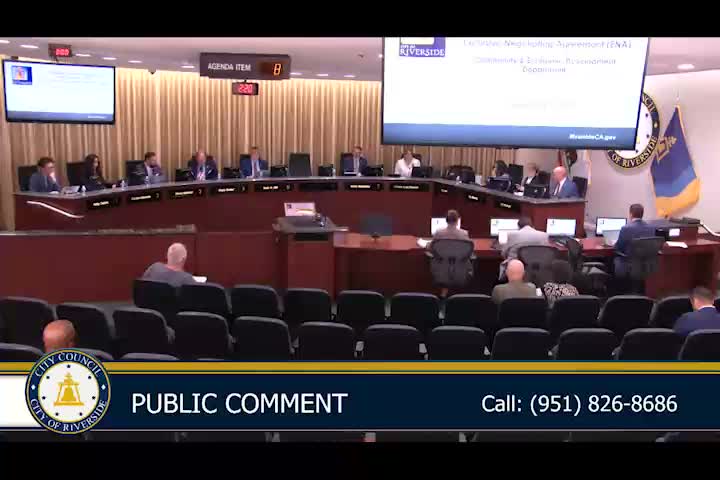
City Council approves exclusive negotiating agreement for proposed Northside sports and entertainment district
Summary
Riverside approved a 12-month exclusive negotiating agreement with GCS Development to negotiate terms for a proposed sports-anchored mixed-use district on a 56-acre Northside site; council emphasized safeguards, community benefits, and that sale vs. lease remains open during negotiations.
Mayor Patricia Dawson and the City Council authorized staff to negotiate an exclusive negotiating agreement (ENA) with GCS Development on Aug. 19 for a proposed Riverside Sports and Entertainment District on a 56-acre city-owned site in the North Side Specific Plan area. The ENA allows the city and developer to negotiate land disposition, a development agreement and community benefits during a 12-month term with a possible six-month extension.
Regine Kennedy, senior planner in the Community and Economic Development Department, told the council the site is the former Ab Brown Sports Complex and is intended by the North Side Specific Plan to be revitalized with recreation, open space, housing, retail and other uses. Greg Scott, CEO of GCS Development, described a master plan centered on a modular 5,000-seat stadium that could expand to roughly 15,000 seats as demand grows, two community fields, an indoor sports complex, a 180-room hotel, a 25,000-square-foot concert venue and mixed-use housing with an affordable component.
Kennedy and the development team emphasized the ENA does not approve the project itself but authorizes staff to negotiate the land sale or lease, development timeline, community benefits, off-ramps and infrastructure responsibilities. Staff told council the ENA requires the developer to deposit funds that will be spent on city staff time and consultant costs and that the city expects negotiations to be cost-neutral for the general fund.
Public commenters were split. Juan Munoz of Unite Here Local 11 urged the city to retain public ownership through a lease model to preserve accountability and long-term revenue; Nicholas Adcock of the Greater Riverside Chambers of Commerce and other business supporters said the project could capture visitor spending and spur North Side economic activity; and Melissa McKeith asked for clarity on the city's potential financial exposure and any public subsidies.
Councilmembers asked how the land would be transferred and whether lease options could be preserved. Staff said lease and sale remain on the table and that the ENA will allow the parties to evaluate both during negotiations. Councilmember Falcone described the ENA as a first step to “have a conversation” and explore whether a lease or sale is preferable; Councilmember Mill called the ENA a "low-risk" step with performance milestones and off-ramps to protect the city.
Councilmember Mill moved and Falcone seconded the staff recommendation; the motion passed unanimously. The vote authorizes the city manager or designee to execute the ENA, including the first six-month extension and minor nonsubstantive changes. Next steps listed by staff include continued community engagement, environmental review and entitlement processing prior to any final sale or development agreement.
The council's action starts a formal negotiation period; if parties reach an agreement, any sale, lease or development agreement would return to the council for public hearings, CEQA review and final approvals. Staff emphasized that the ENA establishes only a negotiation framework and does not commit the city to sell the land or approve the project.
What happens next: staff will pursue outreach with neighborhood groups, continue environmental and entitlement work, and bring negotiated terms back to the council for consideration within the ENA timeframe.