Get Full Government Meeting Transcripts, Videos, & Alerts Forever!
Get email alerts on the Immigration Enforcement Transparency topic
No spam. Unsubscribe anytime.
Riverside council adopts 'Safe Communities' resolution requiring federal agents to identify themselves
Summary
After hours of public comment, the Riverside City Council voted 4–3 on Oct. 14 to adopt a revised Safe Communities resolution urging federal immigration enforcement personnel to use clearly marked vehicles and visible identification, directing local monitoring within legal limits, and calling for public education and monthly reporting.
The Riverside City Council on Oct. 14 adopted a revised "Safe Communities" resolution asking federal immigration enforcement personnel who operate in city limits to clearly identify themselves and their vehicles and directing the city to monitor and publicly report incidents when legally permissible.
Councilmember Clarissa Cervantes introduced the item as a response to increasing reports of unidentified federal agents operating in neighborhoods. "There have been growing reports of multiple people impersonating ICE or law enforcement," Cervantes said in presenting the draft, noting community-collected data that documented "15 confirmed federal enforcement operations in the city, 115 confirmed ICE sightings, and over 200 hotline calls" during a recent reporting period. She said the resolution reaffirms Riverside's commitment to residents "regardless of immigration status" and lays out steps including local monitoring, data privacy safeguards for city systems, a public education campaign and monthly updates to the Human Relations Commission and council.
Why it mattered: Supporters said the measure is intended to rebuild public trust and encourage residents to report crime without fear. Dozens of residents and representatives of immigrant-rights groups described family separations, school and workplace detentions, impersonation incidents and fear that has reduced foot traffic at local businesses. "Our communities are under direct attack," one speaker told the council. Advocates said clearer identification by enforcement personnel and public reporting could reduce impersonation and community trauma.
Council and police input: Chief Larry Gonzales told the council he supported the amendments made to the draft and pointed to the department's existing foreign-nationals policy (Riverside Police Department policy 417) that already addresses many enforcement interactions. The resolution's text was revised during drafting to reflect discussions with the police chief and the city manager; Cervantes said she accepted language changes recommended by staff and law enforcement to ensure the city could implement the measures without impeding lawful policing.
Key provisions: The revised resolution affirms the city's commitment to due process and to implementation of the California Values Act (SB 54); urges federal enforcement personnel to use marked vehicles and visible agency identification; calls on the Riverside Police Department to document suspected federal enforcement activity "when legally permissible"; affirms that city license-plate-reader data will not be shared with federal agencies without a legal warrant; directs the city manager to develop a public-facing webpage with documented incidents and to return in December with options for public education ("know your rights" materials, workshops, inserts in utility bills); and directs the city attorney and manager to monitor federal activity and explore legal or legislative remedies.
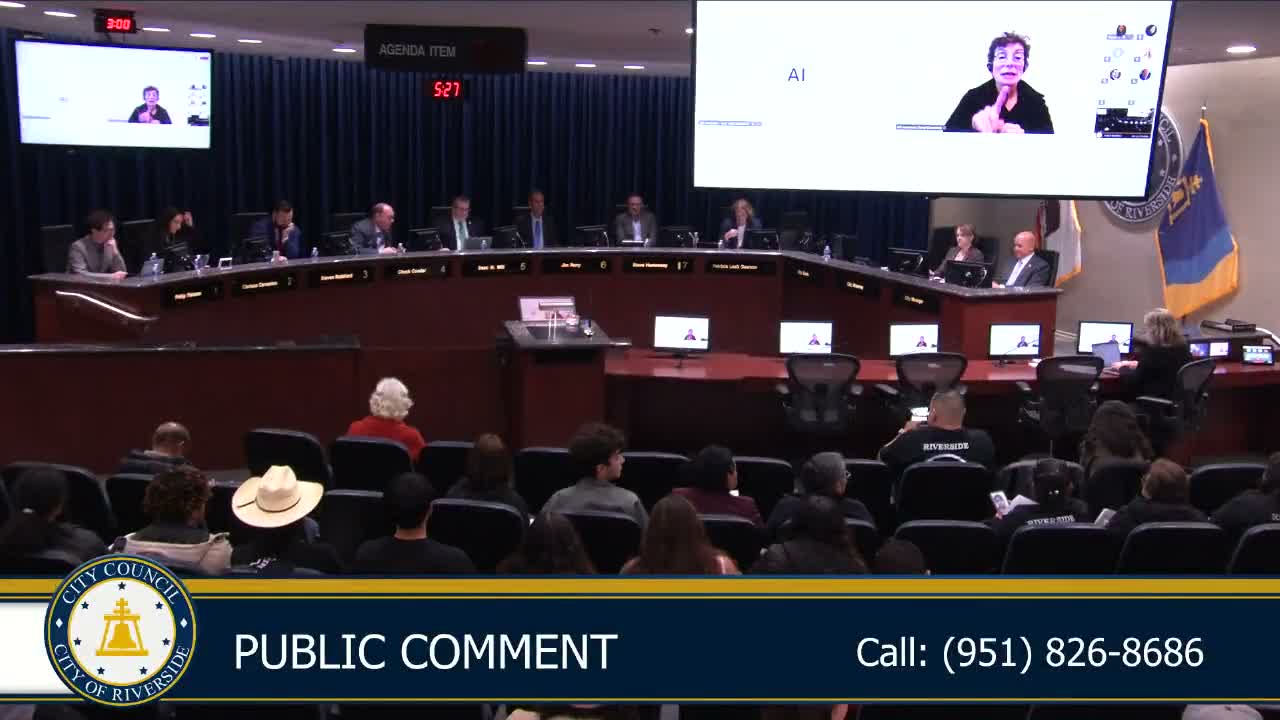
Public reaction: The council heard more than an hour of public testimony from community members, students and nonprofit leaders. University of California, Riverside students and organizers said unmarked vehicles and plainclothes agents have left campus communities feeling unsafe, and organizers from groups including CHIRLA, the Inland Coalition for Immigrant Justice (IC4IJ) and LULAC urged passage. Several speakers described videos and eyewitness accounts of impersonators and of ICE operations that they said lacked transparent identification. A smaller group of callers and speakers opposed the resolution as outside the council's jurisdiction and warned of potential escalation of federal enforcement.
Council debate and vote: Councilmembers split over the measure's scope and likely effects. Supporters framed the resolution as a local statement of values and as a practical tool for documenting incidents and preserving public trust; critics called immigration enforcement a federal responsibility and questioned whether a symbolic local resolution would change federal behavior. Councilmember Romel seconded the motion to adopt the revised resolution. The council approved it 4–3, with the clerk announcing "Motion passes with 4 affirmative votes" and noting three no votes from representatives of Ward 3, Ward 4 and Ward 6.
Next steps: The resolution directs the city manager to create the public reporting webpage and return to council in December with plans for public education and other possible steps. The city will also direct the Riverside Police Department to collect and report documentation of suspected federal enforcement activities within legal boundaries.
What the resolution does not do: The resolution does not impose enforcement authority over federal agencies and explicitly affirms compliance with state and federal law. Several councilmembers cautioned that it is not a cure-all and that federal supremacy limits local power; supporters said the resolution nevertheless gives the community a clearer mechanism for transparency and accountability.
Context and related law: The presentation and public testimony repeatedly referenced California's SB 54 (the California Values Act) and more recent state bills (referred to in the discussion as SB 805 and SB 627) that address agency identification and related safeguards. Advocates said the city-level resolution aligns with and seeks to operationalize aspects of state law locally.
The council's action followed broad public comment and a period of deliberation. The city attorney reported no reportable action from closed session and the meeting adjourned after a brief remembrance for a firefighter who died over the weekend.