Get Full Government Meeting Transcripts, Videos, & Alerts Forever!
Get email alerts on the Council Rules topic
No spam. Unsubscribe anytime.
Riverside council adopts revised rules on meeting schedule, public comment and member timing; six-month check planned
Summary
Council unanimously adopted a set of procedural updates including a formal recommendation (and a commitment) to hold at least one evening meeting a month in summer, clarified public comment rules (speaker cards 'strongly encouraged'), and set council-member speaking limits with a six-month review to assess impacts.
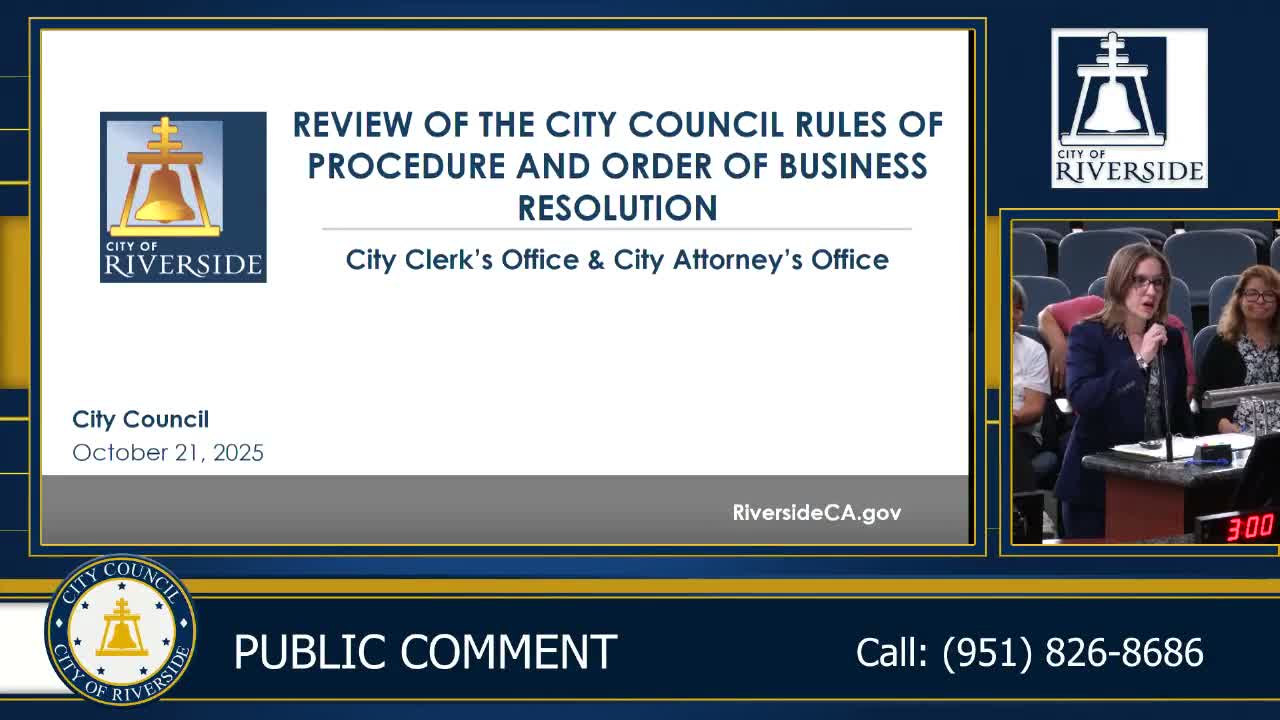
The Riverside City Council unanimously approved updates to its rules of procedure on Tuesday, adopting language that clarifies agenda sequencing, meeting schedules, public-comment procedures and limits on member debate while committing to a six-month review of the changes.
Ruth Ann Solera, senior deputy city attorney, summarized recommendations developed by the Governmental Processes Committee and staff, including changes that would allow the mayor (with mayor pro tem concurrence) to adjust meeting times, clarify the order of business, and consolidate public-comment provisions into one article of the rules. The draft directs that speaker cards be "strongly encouraged" but not required under the Brown Act; it also gives the presiding officer discretion to manage public-comment time based on agenda length and the number of speakers.
The proposal also suggests a voluntary system for timing council remarks: the first opportunity to speak on a discussion item would be 10 minutes, with subsequent turns limited to five minutes. Several council members asked for softer language and a six-month "temperature check" by the Governmental Processes Committee; members agreed to try the limits and revisit them if needed.
Public callers emphasized the importance of evening meetings to increase participation by working residents and urged caution against discretionary restrictions on public comment. Multiple callers, including community volunteers and advocacy groups, said limitations should not undermine meaningful public engagement. Councilmembers discussed balancing efficiency and public access; several supported one evening session a month and a review period to gauge the reforms' effects.
What happens next: the council adopted the resolution to amend the rules and directed staff to return in six months for a committee review of how the changes are working in practice.