
Packed public hearing on Johnston County UDO draws farmers, builders and calls for more time
Get AI-powered insights, summaries, and transcripts
Subscribe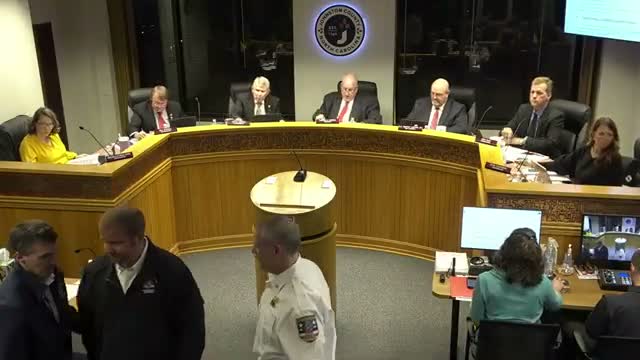
Summary
Hundreds attended a public hearing on Johnston County’s draft Unified Development Ordinance, with farmers, developers and small-business owners urging changes to proposed setbacks, buffers and livestock rules and asking the county to extend stakeholder review before adoption.
A public hearing on Johnston County’s draft Unified Development Ordinance (UDO) drew a lengthy crowd Jan. 20 and a steady stream of speakers who urged the Board of Commissioners to slow the process and give stakeholders more time to work through proposed setbacks, buffers and other new standards.
Planning Director Braston Newton opened the hearing by summarizing the UDO process and legal review timeline, saying outside counsel had completed reviews of several chapters and staff hoped to finish remaining legal review by Feb. 1. Newton described the UDO as the next step following the county’s land‑use plan and consultant engagement and invited public comment.
Developers and homebuilders told commissioners the draft could shrink buildable lot counts and raise costs. Donnie Adams, a local civil engineer and member of the Home Builders Association, highlighted changes to dimensional rules, saying, “the new code draft code, moves up to a 20 foot side setback” and warning that larger setbacks and rear setbacks would make septic design and lot yields more difficult to achieve. Builder Neil Jarmon and developer Rob Bailey presented calculations and maps they said show sizable lot losses in an existing low‑density subdivision; Bailey told the board that, applying the draft buffers and setbacks to his Cattail subdivision, “just alone on the buffers...we would lose 50 lots,” and later summarized combined impacts as “conservatively...90 lots” lost across several provisions.
Speakers representing property owners and realtors raised legal and financial concerns about changes to density calculations. Perry Harris, speaking for property owners and realtors, warned that replacing gross acreage with net acreage (excluding wetlands, buffers and required open space) could “reduce development yield by 20 to 40%” and said such reductions can amount to a down‑zoning event under state law unless owners consent. He said, “If the county adopts dimensional standards and density formulas that reduce development potential without written consent, the ordinance may be challengeable.”
Farmers, equestrians and small urban homesteaders said provisions on livestock, greenhouses and agricultural accessory uses threatened family farms, FFA/4‑H participation and small businesses that supply local homesteaders. Several speakers said they had not seen or digested the 600‑page draft before the hearing and asked for more outreach; one suggested a year of additional stakeholder engagement. Multiple commenters urged town‑hall sessions, clearer notices and use of the county’s Cooperative Extension and Ag Center to reach rural stakeholders.
Commissioners responded that they wanted to “get it right.” Chair (name not given) said the hearing satisfied the statute’s public‑hearing requirement and that additional public meetings were possible, at the board’s discretion. The chair also said, “This is not something we were gonna plan to vote on tonight anyway,” and several commissioners asked staff to compile frequently asked questions, schedule stakeholder meetings at larger venues, and return with a timeline and revised drafts for further review.
What’s next: Newton and planning staff will collect written comments and stakeholder input to refine the draft. Commissioners discussed hosting additional stakeholder sessions and at least one more public hearing—likely at the Ag Center—to allow more people to be seen and heard. The board did not take legislative action on the UDO at the Jan. 20 meeting.