Get Full Government Meeting Transcripts, Videos, & Alerts Forever!
Get email alerts on the General Plan Update topic
No spam. Unsubscribe anytime.
Riverside staff lay out Riverside 2050 general-plan update and climate action work to Cultural Heritage Board
Summary
City planners presented the Riverside 2050 comprehensive general plan update and companion Climate Action and Adaptation Plan, noting transportation accounts for roughly 58% of citywide emissions, and solicited Cultural Heritage Board feedback on historic preservation, design guidelines and outreach.
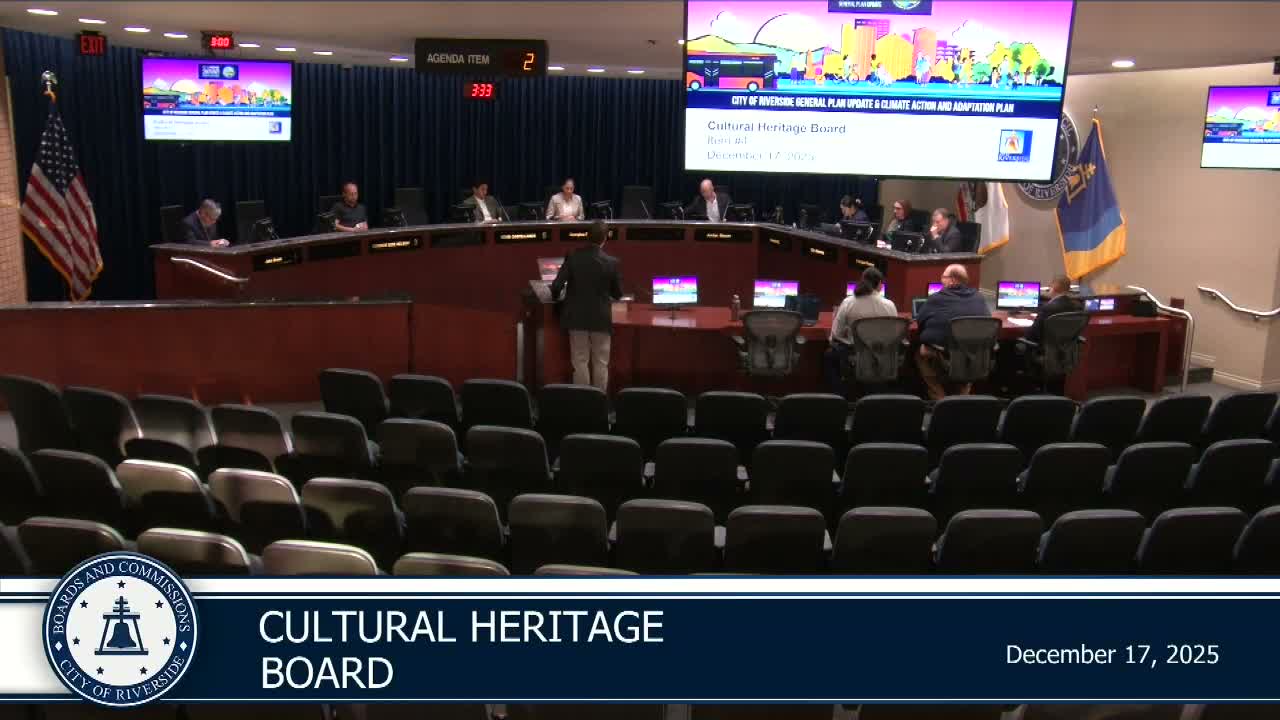
City planning staff presented the Riverside 2050 comprehensive general plan update and its companion Climate Action and Adaptation Plan to the Cultural Heritage Board on Dec. 17, outlining the project scope, early findings from a 2023 greenhouse-gas inventory and the public-engagement approach ahead of draft maps and policies set for public review next spring.
Matthew Taylor, principal planner, said the general-plan update will be a 20–25 year blueprint that includes required elements under California law — housing, land use, public safety, circulation and noise — plus optional elements Riverside plans to include such as arts, culture and historic preservation. "This is our comprehensive general plan update and climate action and adaptation plan project," Taylor said, explaining the city will rewrite zoning, review about 20 specific plans and identify 14 special focus areas (two in each council ward) for tailored policy work.
Fortino Morales, the city’s sustainability manager and co-project manager for the climate plan, reviewed the greenhouse-gas inventory and methodology used. Morales said the inventory used 2023 as the baseline and ClearPath/ICLEI protocols for community-wide accounting. "Transportation, unsurprisingly for a Southern California city, is about 58% of that total," Morales said, with energy sources accounting for most of the remainder and solid waste and water at roughly 2% each.
Board members pressed staff on methodology and coverage. A board member asked whether the inventory included pass-through truck traffic; Morales replied the city’s approach counts trips with an origin or destination inside Riverside and therefore generally excludes pass-through traffic, which the city does not control. Staff said they can follow up with additional service-population metrics and related breakdowns.
Taylor summarized outreach to date and tools residents can use to follow and weigh in: an existing-conditions report and project materials are posted on riverside2050.com, the team has used in-person pop-ups and online mapping (Social Pinpoint) across 28 neighborhoods, and two advisory committees (one for the general plan, one for the climate plan) are active. Taylor said the project began in earnest in 2024 with consultant WSP and that the city will release draft policies and maps for public review in spring 2026.
The board’s feedback emphasized preservation, measurable goals and broader outreach. Several board members praised Riverside’s historic-preservation work and urged more proactive outreach to property owners and developers so residents understand how the plan affects neighborhoods and potential design-review processes. Members recommended demographic projections be shared publicly to help residents visualize 2050 scenarios and suggested school-district outreach helped yield more than 1,700 student artwork submissions for a planned mosaic public art piece.
Board discussion also turned to regional coordination and jurisdictional limits. One member highlighted that infrastructure and natural assets such as the Santa Ana River, freeways and rail corridors involve multiple agencies (federal, county and regional authorities) and urged the city to convene regional partners such as RCTC and Metrolink where possible to address cross-jurisdictional impacts on quality of life.
On historic-preservation specifics, Taylor walked through the existing preservation element’s seven goals — including using preservation principles in planning, proactively identifying and designating cultural resources, and pursuing funding and owner-incentive programs — and said staff will work with the board on which goals to carry forward or revise. The board suggested adding clearer implementation metrics and updating the legal/CEQA context (including references such as AB 52) in the preservation element.
Staff closed by noting next steps and upcoming items: draft climate vulnerability findings are expected for public review soon, land-use concept refinement and public workshops are planned in spring, and adoption of a preferred plan and subsequent CEQA review are targeted through mid-2027. Staff also announced administrative updates including the hire of Andrew Medrano as assistant planner in the historic-preservation role and that the Mills Act application period opens Jan. 1.
The board did not take further formal votes on policy changes at the meeting; the consent calendar was approved earlier in the session. The board will continue to advise staff on preservation priorities and outreach as the Riverside 2050 process moves into public review.