
Polk County health officials seek two staff additions, highlight $6 million HUD lead grant and Narcan distribution limits
Get AI-powered insights, summaries, and transcripts
Subscribe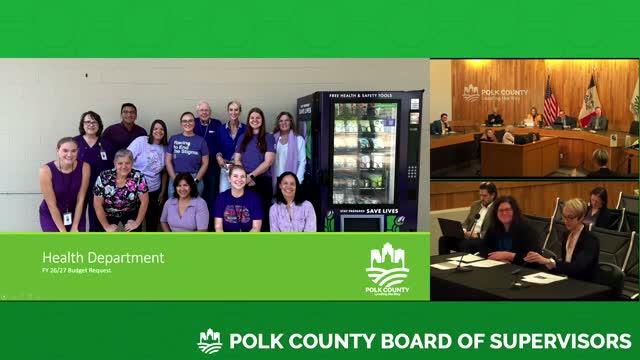
Summary
Health Department presenters told the Board of Supervisors the department's budget includes nearly $1 million in additional revenue driven mainly by grants, including a newly awarded $6 million HUD Lead Hazard Control grant, and requested two FTEs: a community health worker and a Continuous Improvement & Accreditation Coordinator. Presenters also described limits on state-supplied naloxone for unattended vending machines.
Polk County health department leaders asked the Board of Supervisors to approve the department's base budget target and two new positions while outlining program successes and constraints in overdose-prevention supply distribution.
“Our mission is to create the conditions for all people to live healthy lives by empowering individuals, following the science, and building on the strength of our community,” the health department presenter (Speaker 3) said as she opened the budget briefing. She told supervisors the department expects nearly $1 million in additional revenue, most of it grant-driven, and cited a newly awarded HUD Lead Hazard Control grant: “we received another 4 year grant from HUD ... $6,000,000 across 4 years.”
Why it matters: the grant will fund lead‑hazard control work over four years and is recorded in the department's revenue projections, offsetting related grant expenses in the operating budget. The department also described measures to improve clinic revenue after switching away from private‑insurance billing to self‑pay upfront, a change officials said will help stop losses on high‑cost travel vaccines.
The department requested two decision packages: a community health worker to help clients enroll in benefits, arrange transportation and follow up on referrals, and a Continuous Improvement & Accreditation Coordinator to lead performance management and pursue Public Health Accreditation Board (PHAB) accreditation. The presenter said the community health worker would free clinical staff to work at the top of their licensure and that accreditation work would build the department's long‑term capacity and help unlock future funding.
Supervisor Tom (Speaker 4) asked whether the proposed navigator role would overlap with services such as general assistance; the presenter acknowledged similar functions exist in other county programs but said health‑specific training (for example to enroll clients in Medicaid) and language skills justify the new hire. The presenter said the county would prefer bilingual candidates because many clients are not native English speakers.
On harm‑reduction supplies, the presenter described a state requirement that local entities complete training and an attestation to receive state‑supplied naloxone. Because that policy requires an in‑person or staff‑verified training, Polk officials said they cannot legally place state‑supplied naloxone in unattended vending machines; the department has been using opioid‑settlement funds and sporadic donations to stock boxes but warned that those supplies are uneven and unsustainable. “We cannot put these out in our boxes in the community because the boxes are not staffed,” the presenter stated.
County Administrator (Speaker 7) recommended approving the department's base target and called the two requested positions reasonable, but suggested exploring temporary reassignment, a consultant, or other one‑time solutions to begin accreditation work before committing to an additional permanent FTE for continuous improvement.
The Board did not record a formal vote during this presentation; officials moved on to the next agenda item. The health department said it expects to finalize parts of its Community Health Improvement Plan by mid‑March and plans to add an epidemiologist in the coming weeks to strengthen surveillance capacity.