
Burlington district outlines grant portfolio that funds after‑school, mentoring and college‑prep programs
Get AI-powered insights, summaries, and transcripts
Subscribe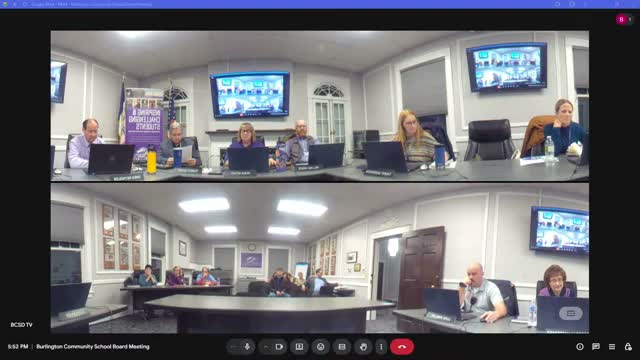
Summary
District staff detailed grant‑funded programs serving hundreds of students — including PIECES after‑school, ClubM mentoring and GEAR UP — noted looming funding reductions in later grant years and asked the board for continued support and transparency on grant applications and outcomes.
District staff provided the Burlington Community School District board with a detailed briefing on the district’s portfolio of competitive grants and how those funds are being used to support students.
At the heart of the presentation, a grants staff member, Sybil, described the PIECES after‑school program — which she said serves “over 250 students” across multiple elementary buildings — and the ClubM mentoring program, which pairs high‑school mentors with elementary students. Natalie Hall, identified in the meeting as the ClubM coordinator, was credited for achieving a recent “gold certification” for the mentoring program.
“Those students, whom are the mentors, they also are quite unique as well. We have 5 of them this year that were once a mentee,” Natalie Hall said, describing how the program grows leadership within returning participants. Sybil told the board the PIECES program is funded through a multi‑year grant and that the district is budgeting roughly $432,000 for that program this year.
The federally funded GEAR UP Iowa program was also discussed; presenters said GEAR UP funds a high‑school GEAR UP coach and related college‑prep programming. A district presenter described the GEAR UP coach position as costing about $67,000 per year and said the grant supports college visits, career exploration and tutoring.
Staff emphasized the administrative work that underpins grant success, including compliance, record‑keeping and interagency coordination. Sybil described the district’s process for finding and applying for grants — monitoring the Iowa grants portal, using superintendent and administrator networks, and cultivating local partnerships and foundations — and said staff maintain a pipeline of opportunities and track both awarded and unsuccessful applications.
Board members asked for clearer reporting on grant timelines and outcomes. One board member asked whether the board could receive not only award notices but also a regular list of grants the district applied for and the results; staff agreed to provide more transparent reporting on both successful and unsuccessful grant applications.
The board was also briefed on changes in some grant budgets that affect programming: presenters said federal 5‑year grant cycles typically reduce funding in years 4 and 5, producing a roughly 25% decrease that the district must plan for. Staff described steps to seek smaller, supplemental grants and local sources to offset decline in larger state or federal grants.
The presentation closed with staff asking the board to continue prioritizing sustainability for long‑running programs and to support staff time for grant management and compliance.
The board took no formal action on grant awards during the meeting; staff committed to follow‑up reports with more detailed itemizations of grant sources, end dates and any anticipated programmatic impacts.