
Higley Unified board selects middle‑path budget (Option 2) after split debate
Get AI-powered insights, summaries, and transcripts
Subscribe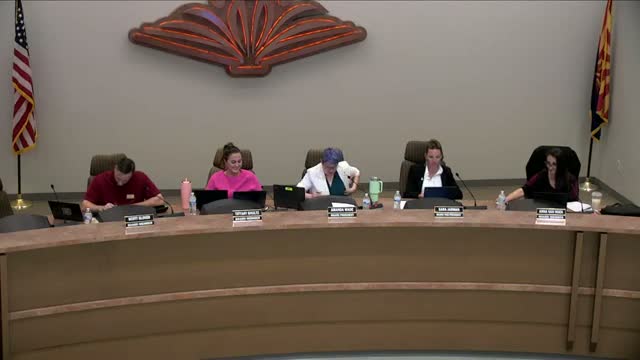
Summary
After extended debate over relying on carry‑forward savings versus deeper recurring cuts, the Higley Unified School District governing board voted 4–1 to adopt budget Option 2, a middle path of reductions intended to preserve programs while narrowing the structural gap.
The Higley Unified School District governing board on Jan. 29 chose a middle‑path budget for fiscal year 2026–27, voting 4–1 to adopt 'Option 2' after a lengthy public presentation and extended board debate.
Superintendent Mr. Lautzenheiser and district finance staff presented a second review of the district’s maintenance and operations budget, outlining a timeline to propose and adopt the FY2027 budget in March–June and noting an anticipated unweighted enrollment decline of about 300 students. CFO Sharon Reschcamp told the board the district faces a phased reduction of override revenue totaling about $4.8 million and projected carry‑forward balances of roughly $19 million. The district also forecast increases in fixed costs, including property/casualty insurance, health insurance and utilities.
The board’s discussion divided around two central tradeoffs: whether to protect staff and current programs now by spending carry forward and taking a smaller immediate hit to employees, or to adopt a deeper reduction now to better align recurring expenditures with falling recurring revenue. One board member described Option 3 (the largest reduction) as the most fiscally responsible approach to shrink the recurring gap; other members argued Option 1 (the smallest reduction) was least disruptive to classrooms and staff, relying largely on attrition.
After failing to secure majority support for Options 3 and 1 in earlier test votes, a motion for Option 2 passed by a 4–1 vote. Board members supporting Option 2 said it offered a balanced approach that preserved programs such as elementary specials and the Mandarin dual immersion program while addressing part of the structural deficit. Members voting in favor emphasized continued oversight of expenses and renewed outreach to the community about funding options. The board asked staff to continue monitoring enrollment and state funding developments and to bring follow‑up information at future budget reviews.
The board’s action is procedural approval to implement reductions consistent with Option 2; specific position reductions, the timing of any attrition‑driven changes, and program impacts will be determined as the district finalizes its M&O and classroom site fund allocations in subsequent budget reviews.
The board will take its third and final M&O review on March 3 and proceed toward a proposed FY2027 budget in June with adoption planned later that month.