Get Full Government Meeting Transcripts, Videos, & Alerts Forever!
Get email alerts on the Ethics Transparency topic
No spam. Unsubscribe anytime.
County attorney delivers required FOIA training to New Kent supervisors
Summary
New Kent County’s deputy/county attorney provided statutorily required Freedom of Information Act training covering definitions of public records, exemptions, FOIA request timelines, public‑meeting rules, closed‑session requirements and civil penalties for willful violations.
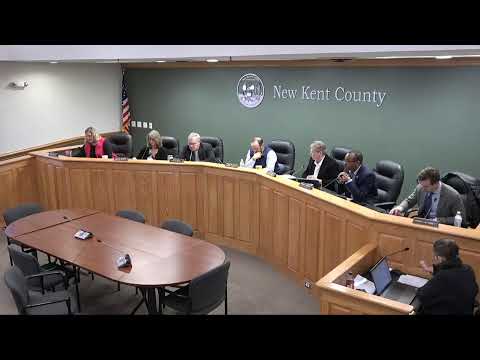
At the Jan. 28 work session County Attorney Hefty delivered the mandatory FOIA training for supervisors, reviewing the obligations associated with public records and public meetings under the Virginia Freedom of Information Act.
Hefty defined a public record as any tangible medium created as part of public business — including emails, text messages, voicemails and social‑media posts — and emphasized that the content, not the device, determines whether a communication is a public record. "If you create it, it's public record," Hefty said, noting that public‑business communications sent from private devices are nonetheless subject to disclosure.
He explained limited statutory exemptions (attorney‑client privilege, personnel, certain law‑enforcement or CPS records) and the five‑working‑day response obligation for FOIA requests (with a potential seven‑day extension for voluminous requests). Hefty named Mr. Hathaway as the county’s FOIA officer and described allowable charges for the actual costs of responding to requests.
On public‑meeting rules Hefty summarized that a gathering of three or more officials discussing public business constitutes a meeting and must be noticed and open to the public, that electronic group communications risk creating an unauthorized meeting, and that closed sessions require a motion citing the statutory code section and a subsequent roll‑call certification upon return to open session. Hefty warned supervisors of civil penalties and attorney‑fee exposure for willful violations.
Supervisors asked clarifying questions about emails and group replies, and Hefty advised limiting group email chains and ensuring official votes are taken only in noticed public meetings. The training session fulfilled the statutory training requirement for the board.