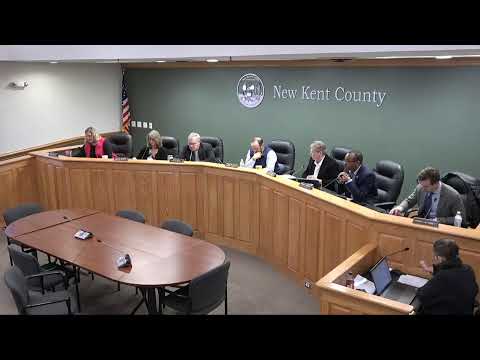
New Kent officials recommend proceeding with Brickshire tank and Route 249 waterline bids; board weighs VRA application and rate impacts
Loading...
Summary
Public Utilities Director Mike Lang recommended moving forward on three water projects (Brickshire tank, associated waterline, Route 249 waterline) after competitive low bids; financial advisers presented multiple borrowing scenarios and urged considering a VRA application by Feb. 6 to preserve bidding and funding options while supervisors asked about rate impacts and development dependence.
New Kent County’s Public Utilities Director Mike Lang urged the Board of Supervisors on Jan. 28 to move forward on three water projects after the county received competitive bids: a Brickshire water tank (low bid $7,965,000), an associated waterline ($1,594,649) and the Route 249 waterline ($4,346,774). Lang said the projects are important to system resiliency, improve water quality (fluoride for Brickshire) and would increase fire flows in growth areas.
Financial advisers presented modeling that examined five funding scenarios and three cash‑policy cases. The staff summary identified roughly $22 million in approved carryforward utility projects and about $13.4 million in additional funding needed to fully fund carryforwards. Scenarios that add Brickshire and Route 249 increase a 2026 borrowing need from a low‑single‑digit million range to the low tens of millions; the advisers discussed options to use prior bond proceeds, cash, and the Virginia Resources Authority (VRA) spring application pool. The VRA application deadline staff noted is Feb. 6; advisers said an application can be provisional and nonbinding to preserve options.
Supervisors pressed staff on household rate impacts and the link between growth assumptions and needed rate increases. One supervisor outlined example bill impacts under a modeled scenario: a household with a $300 every‑other‑month water bill could see increases to $312, $343 and $377 under successive scenarios. Advisers said the model assumes a baseline 4% rate change baked into the 2026 budget, with additional revenue growth (depending on scenario and timing) of a few percentage points to low double digits over multiple years for the most ambitious program. Advisers also described cash‑policy choices (measuring 50% cash as percent of revenues vs. percent of expenses) and the trade‑offs of 20‑year versus 25‑year debt terms to smooth near‑term rate pressure.
Board members asked whether approved developments depend on the projects; staff said most approved developments could move forward under normal operations but that some growth assumptions in the model rely on approved developments actually being built. Lang emphasized some permits and easements are in place and that deferring projects could increase construction costs or cause permit expirations. Staff noted the brickshire/Route 249 bids are good for 60 days and that a mid‑March bid expiry creates a schedule pressure if the board wants to award contracts.
No formal borrowing decision was made at the Jan. 28 work session; staff recommended submitting a nonbinding VRA application to preserve financing options and returning to the board with refined recommendations and an advertisement number for a public hearing should the board want to pursue VRA financing.