
Middleton plan commission reviews draft housing action plan tied to TID extension
Get AI-powered insights, summaries, and transcripts
Sign Up Free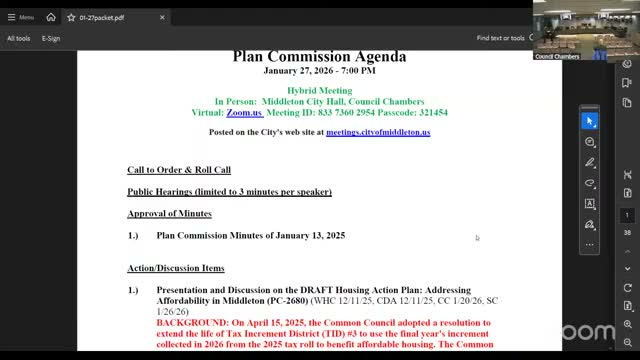
Summary
Plan commission reviewed a draft housing action plan that would use an extension of TID No. 3 to seed an affordable-housing fund (estimated ~$10–11M). Staff proposed gap financing, supportive services, preservation programs and down‑payment assistance; commissioners and a public commenter debated whether TIF extension dollars should fund operating supports.
The Middleton Plan Commission on Jan. 27 reviewed a draft housing action plan that staff and volunteer committees say is designed to guide spending of an extension to Tax Increment District No. 3 and to align city strategy with Dane County goals.
The plan, prepared by the Community Development Authority and workforce housing committees and presented by staff member Scott, lays out four strategies: build more attainable units with gap financing and land acquisition; fund supports and protections for vulnerable tenants; rehabilitate and preserve existing affordable housing; and expand homeownership pathways via nonprofit partnerships. Scott said the initiative is intended as a roadmap, not a budget, and that "we expect to see, coming into it, starting early... approximately 10 to $11,000,000" to seed the fund.
Why it matters: the city council approved an extension of TID No. 3 in April 2025, and state law requires revenue from that extension be used to benefit affordable housing and improve the housing stock. How the city uses the extension matters because TIF revenues divert taxing capacity that otherwise flows to other levies: as public commenter Bill Connors put it, "The thing we're concerned about... is the funding source using this particular funding source, which is coming from extending a TIF district by an extra year." Connors urged that operating supports not be paid from the extension and that capital production be prioritized.
Staff presented cost‑burden data and existing investments, saying 35% of renters and 29% of homeowners in Middleton are cost‑burdened and that the city has previously used about $11,000,000 in TIF plus a $3,000,000 passthrough CDBG grant to incentivize affordable units. Scott described proposed implementation steps for year one: establish the fund, hire a staff person to manage the fund, issue targeted RFPs for developers with documented affordable projects, fund supportive services, and continue housing rehabilitation programs such as the Energy Efficiency Navigator.
Commission discussion focused on design choices and statutory constraints. One commissioner warned against recommending new zoning changes that would increase allowable density in single‑family neighborhoods. Another asked the staff to clarify RFP timing and whether gap financing assumptions should be increased; one commissioner recommended raising per‑unit gap estimates from the plan's $20,000 figure to $40,000 to reflect LIHTC practice in the region.
A substantive point of debate was whether extension funds may pay for operating expenses such as supportive services. Scott said the statute "requires that the funding generated from that extension be used to benefit affordable housing and improve the housing stock" and that the committee believes operating subsidies for required supportive services fall within that direction and precedent exists in other communities. A commissioner read the statute for the record, saying in part: "The city shall use at least 75% of the increments received to benefit affordable housing in the city," and noted the Department of Revenue declined to provide further interpretation, leaving municipal discretion on allowable uses.
Technical program design also drew questions: one commissioner urged structuring home‑repair and energy‑upgrade programs as loans (including forgivable loans recorded against property) where possible so funds can be recaptured and recycled, while staff said small programs sometimes use grants to reduce administrative burden.
Next steps: staff will incorporate commission edits, post the plan for public comment during February (displays at the library and senior center, open houses at the senior center and City Hall), analyze feedback, revise the plan, and present it to the common council for consideration on April 7.
The Plan Commission did not take formal action on the housing plan at the Jan. 27 meeting; staff asked that the commission consider a vote on a revised plan at a March meeting prior to forwarding to council.