Get Full Government Meeting Transcripts, Videos, & Alerts Forever!
Get email alerts on the Cloud Seeding topic
No spam. Unsubscribe anytime.
Lawmakers hear data and push questions on cloud‑seeding pilot in eastern New Mexico
Summary
Legislators in Artesia heard presentations from the Roosevelt Soil & Water Conservation District and New Mexico State University outlining a pilot cloud‑seeding program that ran in spring and summer; presenters reported increases in rainfall metrics and asked for continued funding while lawmakers pressed on attribution, safety, and procurement.
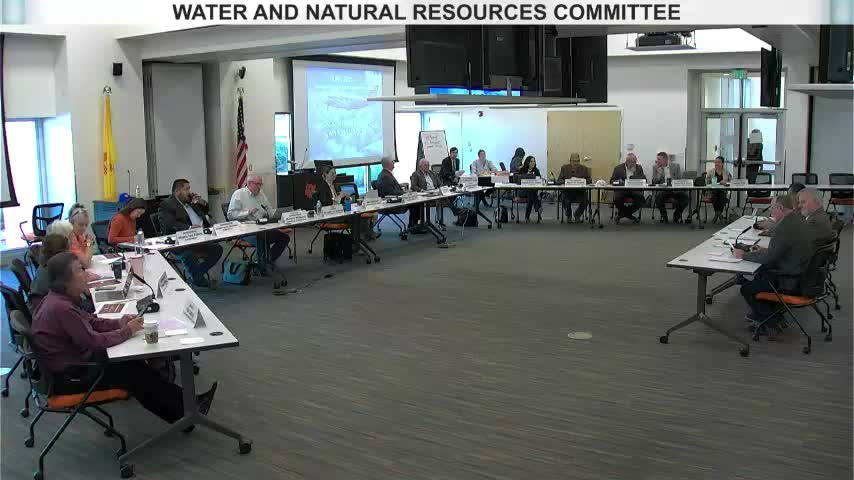
A legislative Water & Natural Resources interim committee hearing in Artesia heard presentations on a state‑funded cloud‑seeding (rainfall enhancement) pilot focused on eastern New Mexico and then questioned presenters at length.
Rick Ledbetter, supervisor of the Roosevelt Soil and Water Conservation District, told the committee the district ran a program funded by the New Mexico legislature that operated in two seasons and produced preliminary estimates the presenters described as an increase in rainfall. Ledbetter said data from a 2024 period showed a 7.4% rainfall increase, producing an additional 603,500 acre‑feet, and that a 2025 period showed a 9.1% increase, producing 1,039,600 acre‑feet, figures he attributed to the district’s statistical evaluation. He asked the committee to consider endorsing and continuing funding for future rainfall‑enhancement activities.
George Beaumar, the program’s consultant, described how the aircraft‑based operation works: pilots fly below cloud base and burn flares containing glaciogenic material (silver iodide) or hygroscopic salts to introduce ice crystals or hygroscopic nuclei into cumulus updrafts so more cloud water converts to raindrops. He said the recent operation flew from bases in Portales and Artesia and used weather radar from the National Weather Service for targeting and post‑event assessment. Beaumar told legislators the $1,000,000 allocated this past cycle went mostly to aircraft operations and seeding material — roughly 85% of costs.
Dr. (transcript: "Doctor DeBois"), the state climatologist at New Mexico State University, briefed legislators on verification and monitoring. He said NMSU used the Zimet weather network, PRISM gridded precipitation data and radar pairing techniques (matching seeded clouds with nearby unseeded clouds) to assess program effects and to reduce experimental 'noise.' He cautioned that long‑term attribution is complex: the region experienced above‑average precipitation in recent years, and he described the program results as suggestive rather than definitive.
Committee members pressed presenters on several technical and policy issues. Representative Kates and others asked where the program’s 1:13 cost‑benefit ratio came from; Beaumar said that ratio is based on experience in the Permian Basin and that NMSU was asked to study Eastern Plains economics to verify a comparable return. Multiple members asked why the program focused on eastern plains rather than mountain snowpack augmentation; presenters said northern/winter seeding has different technical requirements (ground generators) and permit/joint‑powers constraints limited northern expansion this cycle.
Lawmakers also raised environmental and public‑safety concerns. Senators and representatives asked about silver iodide’s toxicity and whether seeding can increase hail or flooding. Beaumar cited multiple studies (Project SkyWater, National Academy of Sciences review, Desert Research Institute, California Energy Commission) and said modeled maximum concentrations are far below federal drinking‑water thresholds; he added the program follows suspension criteria when radar indicates hail risk and does not seed clouds developing hail vaults. Presenters acknowledged some uncertainty remains and emphasized ongoing monitoring and public outreach.
Several members questioned procurement and market capacity: the district reported an RFP produced a single respondent experienced in West Texas and eastern New Mexico operations. The committee also discussed whether local governments or counties contribute funds (presenters said state legislature money primarily funded the recent operations and that some counties declined to participate).
No formal committee action or funding decision was taken at the Artesia meeting; presenters encouraged lawmakers to consider future funding to support verification studies and to expand monitoring networks. The committee recessed for lunch and a planned Sinclair plant tour.