
SLPS recommends RFPs to demolish six vacant buildings; salvage and reuse options to be considered
Get AI-powered insights, summaries, and transcripts
Subscribe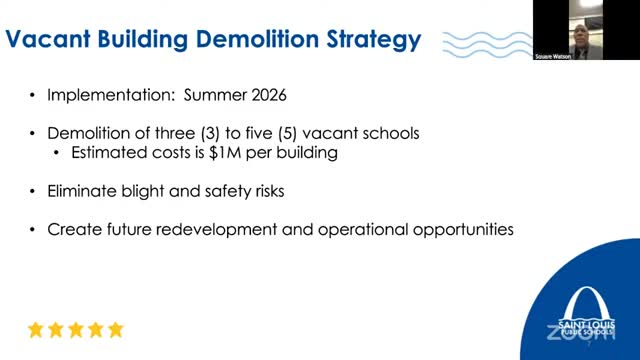
Summary
The district presented recommended criteria and a shortlist of closed buildings for possible demolition — Scullin, Walnut Park, Hempstead, Gunlock, Stowe and Euclid — and said each demolition could cost roughly $1 million; the RFPs will include salvage requirements and community reuse planning with City partners.
The St. Louis Public Schools administration on Tuesday told the board it will prepare requests for proposals to demolish as many as six closed school buildings, citing structural conditions, safety concerns and limited market interest.
Chief Watson said the district used a six‑factor matrix to evaluate closed buildings: (1) structural condition, (2) repair cost versus demolition cost, (3) marketability/redevelopment potential, (4) community impact and preference, (5) ongoing maintenance/utility/insurance costs, and (6) safety risk from vandalism or damage. Using that approach, the district recommended Scullin, Walnut Park, Hempstead, Gunlock, Stowe and Euclid for further action.
"We also work with our real estate broker. They actually went by each of our closed buildings. They took pictures. They looked at...marketability," Chief Watson said, explaining the matrix methodology.
Watson estimated demolition costs of about $1,000,000 per facility, with roughly $500,000 for environmental work and $500,000 for demolition. He said the district will include salvage specifications in RFPs so bidders account for recovering bricks, marble, metal roofing and stained glass where feasible; salvaged materials could offset net costs.
District leaders said reuse planning will be a collaborative process with neighborhood associations, aldermanic offices, the St. Louis Development Corporation (SLDC) and other City partners. Potential post‑demolition uses mentioned included community gardens, urban agriculture, green space and mixed‑use redevelopment, though officials said community input and developer proposals will guide final outcomes.
Funding sources identified in the discussion include ARPA dollars through St. Louis City (CDA) and possible insurance proceeds for buildings damaged by tornadoes; administrators said they are continuing to explore grants and other options.
Board members asked for broad design input from the community and raised soil remediation as a prerequisite if gardens or food production are considered. Administrators said the real estate committee will post meeting dates and return proposals to the board for approval.