Get Full Government Meeting Transcripts, Videos, & Alerts Forever!
Get email alerts on the Trail Safety topic
No spam. Unsubscribe anytime.
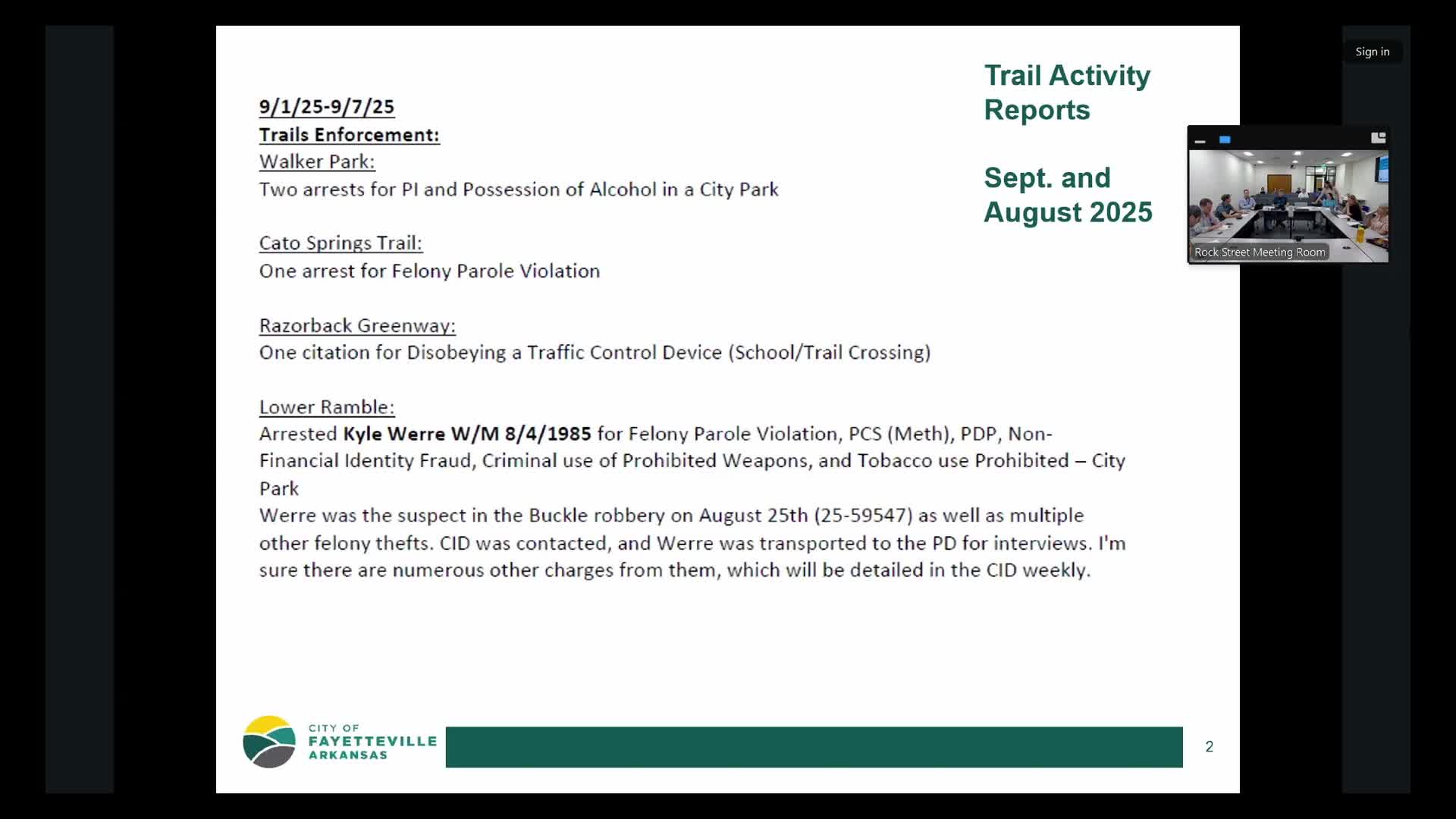
Fayetteville police detail multiple trail and pedestrian crashes; 9‑year‑old collision remains under investigation
Summary
Police Captain Miller reported several recent bicycle and pedestrian collisions — including a hit‑and‑run and a serious crash involving a 9‑year‑old during a Razorback game — and committee members discussed speed data, traffic‑calming thresholds and potential corridor‑level infrastructure changes.
Captain Kevin Miller told the Active Transportation Advisory Committee that police had documented a string of recent collisions on Fayetteville trails and streets, including a hit‑and‑run where officers could not identify the vehicle and a collision involving a 9‑year‑old who darted from a lemonade stand.
“The accident took place during the Razorback football game,” Captain Miller said, and staff have executed a black‑box search warrant to attempt to determine vehicle actions. He said witnesses described the child running into the road and that preliminary checks of the truck’s event recorder did not show an event that would explain the crash.
Miller described other incidents where officers found drivers at fault — at Indian Trail, Royal and St. Loguille, Putty Green Drive and Marco — and said hit‑and‑run investigators circulated a BOLO (be on the lookout) for a Jeep Cherokee with damage to a specific area. He explained that the department documents collisions and follows up when evidence (for example, body‑worn camera video or damaged vehicles seen at body shops) becomes available.
Committee members pressed staff for context on speed and traffic‑calming eligibility. Staff reported a recent speed study with a median speed of about 23 mph and an 80th‑percentile speed around 29–30 mph; the city’s scoring matrix sets 35 points as a typical threshold for traffic‑calming devices such as speed cushions. Members said game‑day parking and congestion can influence both travel speeds and sight lines near schools and residential corridors.
Several members framed the discussion in a safe‑systems approach, noting that faster reaction times, rising hood heights on modern vehicles and corridor design all affect pedestrian survivability. The committee asked staff to track follow‑up investigation findings and to flag any infrastructure changes that could be considered for the affected corridors.
The committee did not take formal action on any of the individual crash investigations; Miller described the status of follow‑up steps and asked staff to return with any recommended engineering changes if the investigations identify modifiable roadway factors.