Get Full Government Meeting Transcripts, Videos, & Alerts Forever!
Get email alerts on the Quantum Policy topic
No spam. Unsubscribe anytime.
Governor's office pitches quantum growth package, seeks 30% CapEx tax refund with $150M cap
Summary
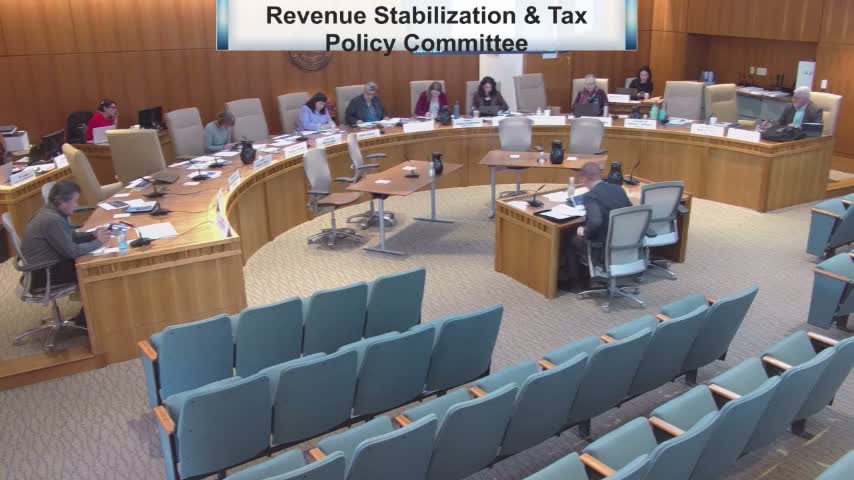
Alex Greenberg of the governor's office told the Revenue Stabilization & Tax Policy committee New Mexico can capture high-paying quantum jobs by pairing federal partnerships with a proposed 30% capital-expenditure tax refund capped at $150 million and targeted workforce training.
Alex Greenberg, economic development policy adviser for the governor's office, told the Revenue Stabilization & Tax Policy interim committee that New Mexico has an opening to convert its research advantage into industry and jobs by backing quantum technology.
—"My name is Alex Greenberg. I'm the economic development policy adviser for the governor's office," Alex said at the start of his briefing, framing the pitch around jobs, national security and supply-chain reshoring. He told lawmakers quantum jobs currently average about $125,000 and that roughly 80% of roles being filled do not require an advanced physics doctorate, meaning technicians, welders and machinists could access durable employment in the field.
Greenberg described a three-part case for state action: the size of the market, national-security urgency and the state's unique local assets. He told the committee New Mexico won a jointly funded federal quantum tech hub (with Colorado) and that DARPA is partnering under a four-year Quantum Benchmarking Initiative in which New Mexico committed roughly $60 million and DARPA will match $60 million. The DARPA program stages include early awards of $1 million (Stage A), $15 million (Stage B) and as much as $300 million at later stages; Greenberg said one local firm is negotiating Stage B work to remain in Albuquerque.
The governor's office is proposing a revived quantum capital-expenditure tax refund, Greenberg said: a 30% refund on qualifying quantum-capital expenditures with a recommended $150 million aggregate cap. He told the committee that to fully utilize a $150 million refund would likely require roughly $500 million of private investment to be spent first, and that the package would rely on a mix of federal partnerships, state incentives and workforce training to produce private-sector follow-on investment.
Greenberg pointed to local ecosystem pieces already in motion: $25 million awarded to a Roadrunner Quantum Venture Studio to spin out lab research, Continuum and Quantinuum's photonics investments, a CNM quantum photonics boot camp to train technicians, and a proposed downtown advanced packaging facility. He argued those pieces, combined with DARPA and the national labs, create the conditions for private firms and suppliers to locate in New Mexico.
Committee members pressed on details. Senator Bergman asked whether the proposal reintroduces language from SB211 and whether a three-year sunset applies; Greenberg identified SB211 and said the administration prefers an aggregate cap rather than a short sunset so companies have stable runway. Representative Chandler asked whether national labs or Triad-managed entities would be eligible; Greenberg said the refund is intended for private industry (C-corps, LLCs) and would exclude Department of Energy labs and their management contractors.
Lawmakers also sought plain-language clarification on technical points, including the difference between physical and logical (error-corrected) qubits and how many would be needed to threaten RSA encryption; Greenberg reiterated industry uncertainty and said current systems have many physical qubits but only dozens of logical qubits, so the state should prepare now for post-quantum cryptography adoption.
Greenberg repeatedly framed the proposal as a measured, place-based effort to capture supply-chain and fabrication firms as well as qubit builders, while enabling workforce pipelines that can reach rural communities. He recommended pairing the 30% refund with other targeted incentives and training so the state captures both the manufacturing "picks-and-shovels" suppliers and the higher-end qubit builders.
Next steps: Greenberg said the administration intends to reintroduce the quantum tax package in the next session and seek committee review; the committee did not vote on the proposal at the interim hearing.