Kansas committee hears SB 144 to limit HOA bans on rooftop solar; proponents cite selective enforcement, opponents cite contract limits
Summary
A Senate committee heard SB 144, which would invalidate HOA covenants that bar rooftop solar and require HOAs to adopt 'reasonable' rules. Supporters described selective enforcement and practical barriers to amending covenants; opponents warned of constitutional concerns and problems in maintenance-provided communities. No vote was taken.
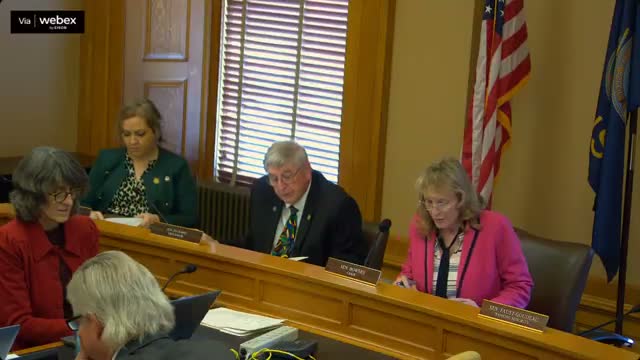
A Senate committee held a hearing on SB 144, a bill to invalidate homeowners association (HOA) covenants that prohibit rooftop solar and to allow HOA boards to adopt "reasonable" rules governing installations.
Senator Holscher, the bill sponsor, told the committee the proposal grew out of constituent complaints in Johnson County and Senate District 8 about decades-old covenants that block homeowners from adding solar. "This bill is the result directly of constituent feedback," she said, adding the measure would not force HOAs to accept panels but would require associations to revisit antiquated rules and be able to adopt reasonable standards that comply with local ordinances.
Proponents described practical hurdles that make covenant changes difficult. Nicholas Simara, a Foxfield Village homeowner and long-time HOA board president, said his community's declaration—adopted by the developer 25 years ago—treats solar as an "unsightly projection" and requires a two‑thirds owner vote to amend. He called that threshold "almost a nonstarter," given low homeowner turnout at routine meetings.
Homeowner Gokul Romani recounted a selective-enforcement episode in which two nearby homes had permitted solar arrays while his similar, fully permitted installation was initially rejected by his HOA. "I later learned that the same HOA leadership had approved prior installations, but not mine," Romani said, describing a multi-month administrative process that only resolved after leadership changed.
Environmental advocates urged legislative action. Zac Pastora, state director for the Sierra Club, said more than 32 states have so‑called solar access laws and framed SB 144 as a way to expand affordable, local energy production. A Sierra Club WebEx witness provided examples of what "reasonable" rules might look like—panel tilt, minimal overhang, concealed conduit and color/finish options—so installations are both effective and visually compatible with neighborhood standards.
Supporters also argued economic and resilience benefits. Herbert "Jake" Harry, who described himself as a homeowner and renewable-industry professional, urged the committee to "lift the burden" of outdated covenants and said local generation can improve energy security. In his testimony he cited a Kansas Corporation Commission settlement involving Evergy and offered dollar figures for claimed rate impacts; those figures are presented here as his testimony and have not been independently confirmed by the committee record.
Opponents raised legal and practical objections. Rod Hoffman, a lawyer who represents HOAs, warned the committee about potential constitutional issues under Article I, Section 10 of the U.S. Constitution, arguing that recorded covenants are contracts and that the state should not lightly impair contractual rights. He also said the word "reasonable" is inherently subjective and recommended carving out "maintenance‑provided" communities—where the HOA controls and insures roofs—from the bill because removing and reinstalling panels after hail or roof work can be costly and complex.
Committee members asked follow-up questions about the bill's drafting (how to define "reasonable"), outreach to HOAs, the prevalence of problem cases across districts, and the homeowner amendment threshold. Senators discussed whether language limiting the bill to owner‑controlled rooftops or adding clear standards for reasonable rules would be appropriate amendments if the committee moves the bill forward.
The hearing concluded with no formal vote; the chair said the committee will consider testimony and any suggested drafting changes before deciding whether to advance SB 144.