Watershed chief says finishing or narrowing consent decree could free up $600–$700 million; updates on staffing, AMI and water taste/odor issues
Loading...
Summary
Commissioner Heyerley told the City Utilities Committee that progress under the consent decree could allow the city to redeploy an estimated $600–$700 million toward other utility needs; he also briefed the committee on staffing, AMI pilot work with Georgia Tech and recent taste-and-odor events linked to MIB/Jensen compounds in Lake Lanier.
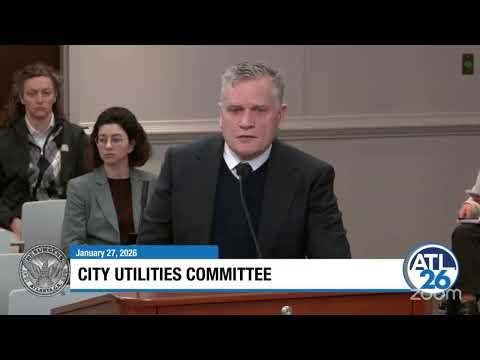
Commissioner Heyerley delivered the Department of Watershed Management's quarterly briefing on Jan. 30, outlining staffing changes, compliance achievements and priorities for capital investment. He said the department is actively recruiting leadership roles, converting extra-help positions into regular posts and continuing condition assessments that will inform a multi-year capital plan.
Heyerley highlighted recognition the department received for financial reporting and laboratory accreditation and said all water treatment plants were in compliance. He emphasized that the department will prioritize investment in water treatment plants and distribution, noting that treating root causes at treatment facilities is essential to preventing breaks and ensuring pressure and safe service citywide.
On the long-running federal consent decree, Heyerley said the city has made substantial progress and is collaborating with the U.S. Environmental Protection Agency. He identified three possible trajectories in federal talks — extension with current scope, an extension with reduced scope, or a declaration of compliance — and said all scenarios remain under consideration. "If we're able to just finish the projects we're working on now and not have to complete every project listed in the consent decree, it could free up potentially 600 to $700,000,000 that's encumbered towards the consent decree to be reinvested in other parts of the utility," he said.
Heyerley also addressed a water taste-and-odor event tied to compounds identified as MIB and "Jensen" in the briefing. He stated the utility measured concentrations in Lake Lanier up to 1,000 parts per trillion (ppt), noted the compounds are detectable at very low levels and said they create an earthy taste though they are considered harmless. The department discussed treatment options including activated carbon (used now) and ozone (more effective but costly), and said it will continue studying causes and remedies.
The commissioner described an AMI (advanced metering infrastructure) pilot with Georgia Tech to provide near-real-time customer data on usage, pressure and quality—tools that could speed leak detection and enable more accurate billing. He said the department will pursue plant upgrades, condition assessments and partnerships, and will return additional detail on RM Clayton improvements and hydrant repair status in subsequent briefings.
Members pressed on communications, remediation follow-through after repairs, hydrant crew capacity and whether funds freed from any change in the consent decree could be spent on preventive measures such as street-tree plantings or a stormwater utility. Heyerley said state and federal constraints influence what funds can be used for, but a dedicated stormwater utility would create more targeted flexibility for stormwater investments.