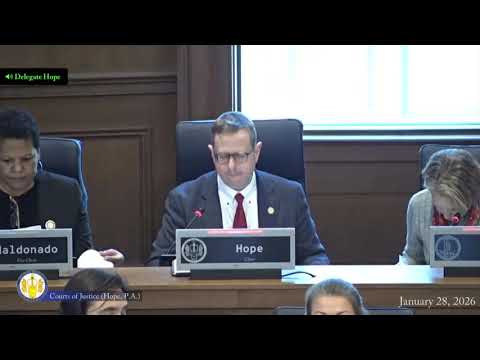
Justice Committee advances multiple criminal-justice measures to appropriations, including sentence-modification and payment-credit bills
Loading...
Summary
The House Justice Committee reported several criminal justice bills to Appropriations, including HB16 (crediting community service performed while incarcerated toward fines and costs), HB17 (extending the delinquency window from 90 to 180 days and requiring deferred payment agreements) and HB26 (automatic hearings to consider modifying certain marijuana sentences).
The House Justice Committee on Thursday advanced a package of criminal-justice bills and sent several measures to the Appropriations Committee for further review.
Chair Watts moved the subcommittee amendments and reported HB16, which would allow community service performed while incarcerated to count toward payment of fines and costs, including service performed on or after July 1, 2020. "The goal of HB16 is to... count community service work done while incarcerated in a jail or prison towards the payment of fines and costs," Chair Watts said during the committee's consideration. The committee voted to report the bill and refer it to Appropriations.
The committee also moved HB17 with subcommittee amendments. The bill extends the current 90-day period to 180 days before fines and cost accounts are declared delinquent and requires that, when a defendant is sentenced to an active term of incarceration, the defendant be entered into a deferred payment agreement with a due date no earlier than the defendant's scheduled release. Chair Watts said the change is intended to provide more time and structure for repayment planning; the committee reported HB17 and referred it to Appropriations.
Another notable measure, HB26, was reported with a committee substitute and referred to Appropriations. Under the substitute, the bill establishes a process for automatic hearings to consider modifying sentences for people convicted of certain felony marijuana offenses committed before July 1, 2021, if the person is still incarcerated or on community supervision by July 1, 2026. The substitute clarifies that adjudications as a delinquent juvenile may participate and that any sentence modification may address only the marijuana convictions. The substitute includes a sunset provision, limiting hearings to applications filed during a window that ends in July 2029.
Other criminal bills reported or moved included measures addressing discovery and access to body-worn and dashboard camera footage (HB118, reported with a substitute), adjustments to robbery degrees codified after 2020 changes (HB244), earned sentence credits (HB361, reported as amended), court fee waivers for indigent defendants (HB660), and adjustments to fees related to emergency custody proceedings and special justices (HB754). Several of the reported bills were moved as part of an uncontested block earlier in the hearing.
Votes were recorded on the floor. For example, some roll-call exchanges recorded "No" votes during the HB26 roll call (members Whittle and Pence recorded "No" on the roll), and other bills were reported unanimously or with clear roll-call margins. The committee's actions send multiple criminal justice proposals to the next stage of budgetary and subject-matter review in Appropriations.
Next steps: Reported bills will proceed to the Appropriations Committee or their next assigned committee for further consideration; the committee record shows reported motions and roll-call records for the measures sent forward.