
Subcommittee hears emotional testimony and technical debate on bill to reclassify kratom alkaloids; no vote taken
Get AI-powered insights, summaries, and transcripts
Subscribe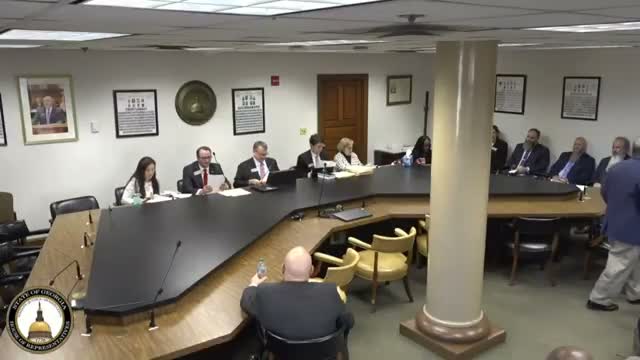
Summary
The Judiciary Noncivil subcommittee held an extended hearing on House Bill 968 to classify kratom alkaloids and certain high‑potency products as Schedule I. Poison center data and family testimonies pushed for a ban; industry and regulators urged targeted scheduling of synthetics and stronger enforcement. The subcommittee took no vote and asked for legal review.
The Judiciary Noncivil subcommittee heard three hours of testimony and debate on House Bill 968, a proposal to reclassify kratom alkaloids (including mitragynine and 7‑hydroxymitragynine) and related high‑potency products as Schedule I. Sponsor Representative Townsend (referred to as Rick in floor remarks) said he brought the bill on behalf of constituents after discovering manufacturers and retailers were selling products that exceed legal limits and hide ingredients from consumers.
Medical and public‑health witnesses told personal stories and presented clinical data. Patrick Filkins, faculty toxicologist and assistant director of the Georgia Poison Center, told the panel that the center has recorded 503 kratom exposures in Georgia since 2021 and described a 66 percent increase from 2022 to 2025 in reported cases. "Since 2021, just in Georgia, we've had 503 cases of kratom toxicity reported to our center," Filkins said, and he warned that modern products are frequently spiked with synthetic metabolites that can be far more potent than the natural leaf.
Family members who lost relatives described sudden deaths and prolonged addiction they attribute to kratom products. Karen Davenport, a nurse practitioner who said her son died on 03/18/2024 from mitragynine toxicity, urged lawmakers to ban the substance. Several witnesses from recovery communities and treatment providers described people who developed dependence and severe withdrawal.
Law enforcement and prosecutors provided a law‑and‑order perspective. Kent Johnson, a narcotics investigator with a northwest Georgia drug task force, said vendors are selling potent synthetic products (referred to in testimony as "7‑OH" and pseudoendoxyl) that are markedly stronger than traditional kratom leaf preparations. Jason Smith, a district attorney from the Tallapoosa Circuit, and Robert Smith, general counsel for the Prosecuting Attorneys' Council, warned that statutory drafting choices can create prosecutorial problems because Georgia's definition of a "controlled substance" references both state and federal schedules; Smith cautioned that a statute as drafted could produce arrests that prosecutors cannot successfully pursue in court.
Industry representatives and lawyers for botanical producers argued for narrower language and stronger enforcement rather than a broad ban. Robert Highsmith (Holland & Knight) and a representative of Botanicals for Better Health said the harms described at the hearing largely stem from synthetic, highly concentrated metabolites and not from traditional leaf products; they urged the committee to schedule specific metabolites and enhance enforcement and product‑registration systems instead of criminalizing the natural leaf.
Regulatory and former federal officials described options and tradeoffs. Bob Durkin, a former FDA dietary‑supplement official working with industry groups, said kratom can qualify as a botanical/dietary ingredient under federal law if properly marketed; he warned that a total ban could drive adulterated black‑market products and make quality control more difficult.
Witnesses on both sides presented laboratory and anecdotal evidence. Eli Cohen, an attorney who said he sues kratom manufacturers, described sending purchased products to a laboratory that returned results showing far higher levels of 7‑hydroxymitragynine than labels disclosed. Cohen argued that the industry repeatedly skirts labeling and that a ban is necessary to prevent further harm.
Members of the committee highlighted competing risks: several said public safety and rising poison‑center reports argue for decisive action; others emphasized the collateral consequences of scheduling (criminalization, enforcement limits) and urged narrower statutory language and additional regulatory tools. Maisie Lynn Gertin (Georgia Association of Criminal Defense Lawyers) and others warned about criminalizing people with addiction and about unintended collateral effects.
After extended testimony and procedural questions—including legal concerns about whether Georgia scheduling requires parallel federal scheduling—the chair declared the meeting a hearing only and asked staff and counsel to provide additional legal analysis and drafting options. No committee vote on HB 968 was recorded in the transcript.
The subcommittee adjourned with the sponsor saying he will seek guidance on whether an outright ban is legally feasible and whether targeted scheduling of synthetic metabolites, enforcement improvements, or registration and lab‑reporting mechanisms would achieve public‑safety goals.
What happens next: the subcommittee will hold further discussion and likely request legal opinions and model language so members can choose between a broad ban, narrow scheduling of specific metabolites, or enhanced regulatory/enforcement measures.