Get Full Government Meeting Transcripts, Videos, & Alerts Forever!
Get email alerts on the Property Taxes Reappraisal topic
No spam. Unsubscribe anytime.
Dallas Central Appraisal District lays out residential reappraisal process for Farmers Branch homeowners
Summary
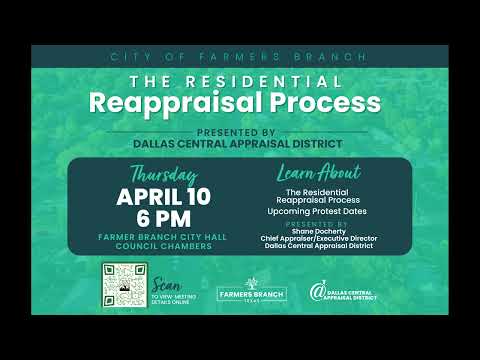
At a Farmers Branch workshop, DCAD chief appraiser Shane Dougherty explained how the district builds neighborhood‑level mass‑appraisal models, how land and improvement values are allocated, how notices and protests work (appraisal notices April 15; protest deadline May 15), and what owners should submit to seek corrections.
Dallas Central Appraisal District Chief Appraiser Shane Dougherty told a Farmers Branch workshop that DCAD’s job is ‘‘to establish the fair market value of all properties within a county appraisal district’’ as of the assessment date — January 1 — and that the district provides an appraisal roll to taxing jurisdictions across Dallas County.
Dougherty described DCAD’s residential approach as mass appraisal by neighborhood and building class: ‘‘We build models by neighborhood, by building class,’’ he said, noting DCAD maintains thousands of targeted models so values reflect local resale patterns rather than a single city‑wide formula. He said DCAD uses three ratio studies each cycle to identify neighborhoods that fall outside a 95–103% assessment ratio and will target them for reappraisal.
DCAD will mail proposed appraisal notices in mid‑April and make the appraisal roll available online; owners have until the stated protest deadline (May 15) to file. ‘‘We’ll be mailing out, over 600,000 appraisal notices on Monday,’’ Dougherty said, and urged property owners to review the notice, then ‘‘submit your documentation with your protest, your evidence, and your opinion of value’’ via DCAD’s UFile online system or by other means.
On evidence and appeals, Dougherty said DCAD supplies the neighborhood‑level sales information and a neighborhood value review when a protest is flagged: ‘‘At the time you file your protest … that neighborhood value review will give you every property that’s in your neighborhood, the address, the account number, the market value of that property, and any known sales information we have.’’ He explained that during an informal review DCAD will compare the owner’s evidence and, if possible, reach an agreement; if not, the owner may go before the appraisal review board (ARB), a citizen panel that hears evidence and issues determinations.
Dougherty also explained that Texas law requires DCAD to split total market value into land and improvement components. When builders buy lots and tear down older houses, ‘‘we’re gonna establish a land value’’ from those land sales, he said. That can reduce the allocated improvement value for older homes in the same neighborhood if tear‑down sales drive land prices up.
On exemptions, Dougherty cited recent legislation requiring appraisal districts to review homestead exemptions at least every five years and said DCAD audits exemptions and will notify owners when records appear irregular. He summarized the capped homestead rule: an owner’s homestead appraised value is subject to a 10% annual cap on increases, which may mean taxable value for homesteaded properties rises more slowly than total market value.
Dougherty clarified tax freezes for eligible seniors: ‘‘If you’re 65, your county taxes are frozen. Your school district taxes are frozen’’ for the year the owner qualifies, but he noted city, hospital and community‑college levies can still change because those entities are not automatically frozen by the senior freeze.
On building permits and record accuracy, Dougherty said DCAD receives monthly permit files from 31 cities and inspects properties when permits indicate changes that would affect value. He reported a recent three‑year permit audit in Farmers Branch found only two missing permits, which DCAD subsequently added to the roll.
Dougherty addressed AI and predictive tools, saying DCAD uses predictive modeling but is not deploying automated AI to run hearings: ‘‘We’re not using AI … we like how we build our models’’ and an appraiser should be present to answer questions during appeals.
Dougherty closed by reiterating owner remedies and timelines: if a property description or value seems wrong, owners should file a protest, provide evidence, use the neighborhood value review and, if needed, pursue an informal settlement, ARB hearing, binding arbitration or court appeal. He urged homeowners to ‘‘be proactive’’ and to verify their appraisal notice and exemption status online or by calling DCAD.
The workshop was hosted by Stacy Henderson, Farmers Branch city secretary. DCAD staff present included Deputy Chief Appraiser Cheryl Jordan and Patricia Nixon (community relations). No formal votes or policy changes were taken at the event; the workshop focused on explanation and Q&A. The next step for owners is to review mailed or posted appraisal notices and file protests by the published May 15 deadline if they disagree with the proposed values.